Madhya Pradesh High Court Upholds IT Rule 3(1)(b)(iv): What Brand Owners Should Know About Social Media IP Takedowns
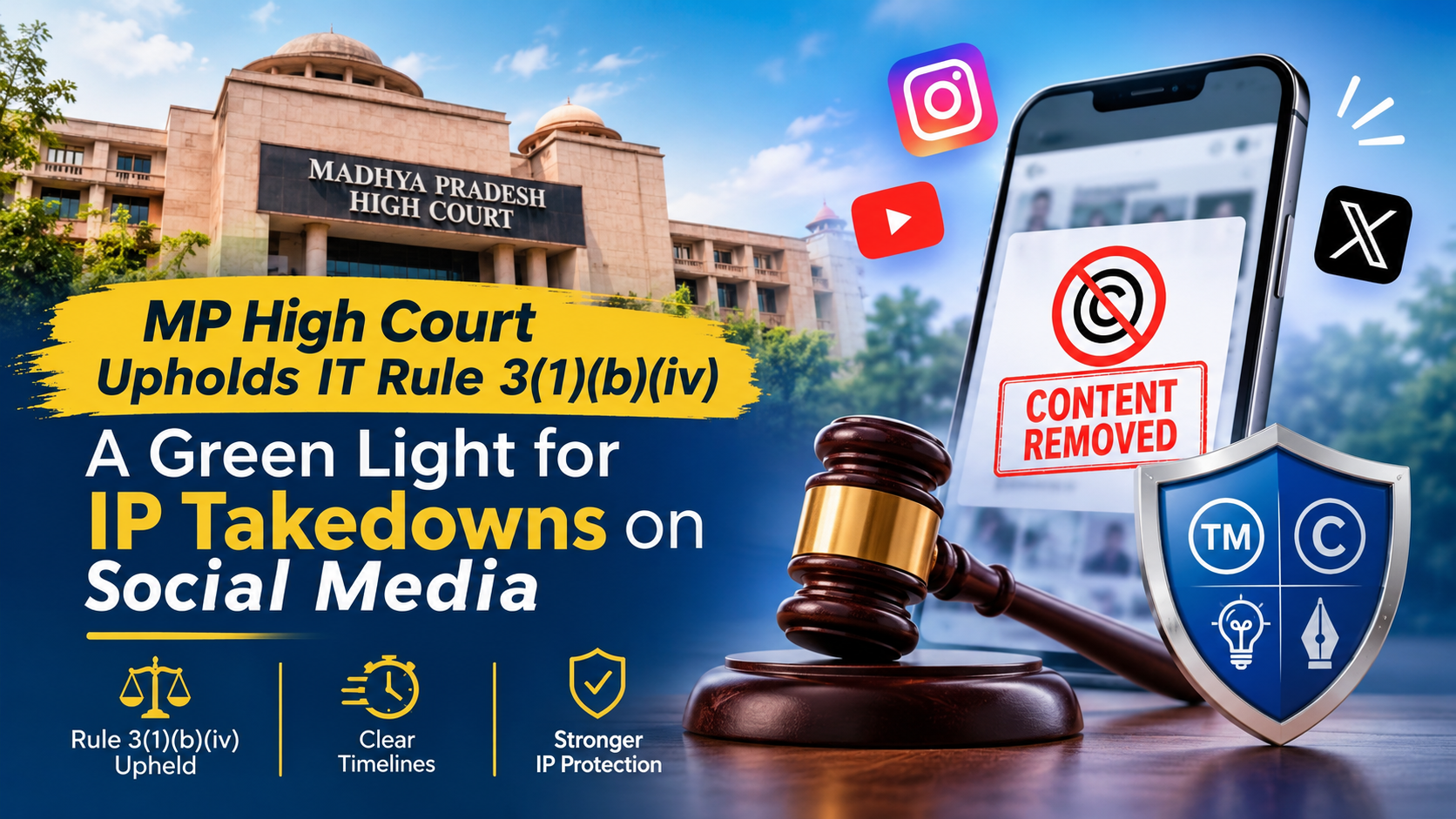
Madhya Pradesh High Court Upholds IT Rule 3(1)(b)(iv): What Brand Owners Should Know About Social Media IP Takedowns
By the ArcticInvent IP Research Team | 13 November 2026
The Madhya Pradesh High Court at Jabalpur has, by a Division Bench judgment in Anmol Jain v. Union of India & Ors., Writ Petition No. 4503 of 2026 (neutral citation: 2026:MPHC-JBP:73411), decided on 17 September 2026, dismissed a constitutional challenge to Rule 3(1)(b)(iv) of the Information Technology (Intermediary Guidelines and Digital Media Ethics Code) Rules, 2021, and confirmed the constitutional pathway for IP-takedown notices against social media intermediaries. The judgment was authored by Justice Vivek Rusia, with Chief Justice Alpesh Y. Kogje on the Bench.
The petitioner the creator of an Instagram page had challenged Rule 3(1)(b)(iv) under Articles 14, 19(1)(a), 19(1)(g) and 21 of the Constitution after Instagram had removed specific posts and suspended his account in response to third-party copyright complaints. The Division Bench held that Rule 3(1)(b)(iv) which obligates intermediaries to prohibit users from hosting content that infringes patents, trademarks, copyrights, or other proprietary rights passes constitutional muster because the Rule 3 framework already lays down three independent safeguards for users. Brand owners can now structure their takedown programme around the Rule with confidence.
What the Court Actually Held
The Bench disposed of the constitutional challenge by reading Rule 3(1)(b)(iv) together with three procedural safeguards that, taken jointly, defeat every Article 14, Article 19 and Article 21 ground raised by the petitioner:
- Grievance Officer review under Rule 3(2) of every takedown notice.
- A right of appeal to the Grievance Appellate Committee (GAC) under Rule 3A within 30 days of the Grievance Officer's decision.
- Statutory remedies under the Information Technology Act, 2000 including adjudication and appellate mechanisms under Chapters IX and X remain available to aggrieved parties alongside the platform-level grievance framework.
The Bench's ratio is that the existence of these three procedural layers is sufficient to convert what would otherwise be a private takedown into a regulated, contested decision capable of supporting the underlying Rule's validity.
The IT Rules, 2021 Pathway, with Statutory Timelines
Brand owners should map their takedown workflow against Rule 3(1)(b)(iv) read with Rule 3(2), and not collapse it into the court-order track under Rule 3(1)(d). The two paths produce different statutory SLAs.
Private IP notices — Rule 3(1)(b)(iv) read with Rule 3(2)(a)(i): the platform's Grievance Officer must acknowledge the complaint within 24 hours and resolve it within 7 days (shortened from 15 days under the February 2026 IT Rules Amendment). The proviso to Rule 3(2)(a)(i) expressly excludes sub-clause (iv) for IP infringement from the 36-hour fast-track window (reduced from 72 hours in February 2026) that applies to most other Rule 3(1)(b) takedowns IP takedowns accordingly get the 24-hour acknowledgement plus 7-day resolution treatment, not the 36-hour fast track.
Court or government orders — Rule 3(1)(d): intermediaries must remove or disable access within 3 hours (tightened from 36 hours under the February 2026 IT Rules Amendment). The constitutional scope of "actual knowledge" under Rule 3(1)(d) was settled by the Supreme Court in Shreya Singhal v. Union of India (2015): Rule 3(1)(d) is triggered only by court orders or notifications from appropriate government agencies, not by private brand-owner notices. Brand owners who send private notices citing Rule 3(1)(d) without a court order risk having their complaints disregarded, as platforms are not legally deemed to have 'actual knowledge' under Rule 3(1)(d) from private notices alone.
Copyright-specific provisional takedown — Rule 75 of the Copyright Rules, 2013: the rights holder may secure a provisional takedown for 21 days, within which the rights holder must produce a court order to convert the provisional removal into a permanent one. If the rights holder fails to obtain and submit a court order within the 21-day window, the platform is permitted to restore the content and decline repeat notices for that same work at that URL. Rule 75 should therefore be invoked selectively, only when the brand owner is prepared to seek immediate litigation under the Copyright Act, 1957. For routine takedowns where no imminent litigation is planned, Rule 3(1)(b)(iv) read with Rule 3(2) is the safer operational route.
Refining the Section 79 Safe Harbour
The Section 79 safe harbour under the IT Act, 2000 protects intermediaries against IP-infringement liability only if the intermediary complies with Rule 3 due diligence and acts on URL-specific information, as held by the Delhi High Court in MySpace Inc. v. Super Cassettes Industries Ltd. Vague keyword complaints clear neither prong and may even strip the platform of its own safe harbour.
Practical Best Practices for Brand Owners
Three operational shifts that decision-stage brand owners and in-house IP counsel should adopt now:
- Submit URL-specific notices. Every complaint to the Grievance Officer should list specific URLs or post IDs, not keyword searches. URL-level specificity is the doctrinal anchor for preserving the platform's Section 79 safe harbour and getting past the Grievance Officer review.
- Document IP ownership and standing up front. The Rule 3(2)(a)(i) complaint must identify the IP right, the registration or first-publication evidence, and the territorial nexus. Without this documentation, the Grievance Officer is entitled to reject the complaint at the 24-hour acknowledgement step.
- Anticipate counter-appeals before the GAC. A user whose posts are removed under Rule 3(1)(b)(iv) has 30 days to appeal to the GAC under Rule 3A. Brand owners should expect a GAC reversal possibility on procedural grounds and prepare to defend their notice record at the appellate stage.
Brand owners and in-house counsel looking to operationalise these pathways can engage ArcticInvent for assistance with trademark and copyright registration, building URL-specific Rule 3(1)(b)(iv) takedown workflows, and end-to-end online brand protection programmes in India. Our team maps Section 79 safe-harbour strategy and parallel Rule 75 litigation routes against each client's portfolio write to us through the ArcticInvent contact page [INSERT CONTACT URL] to scope a brand-protection engagement.
FAQs
Does the Anmol Jain verdict bind courts outside Madhya Pradesh?
The judgment binds the Madhya Pradesh Subordinate judiciary directly and is persuasive before the Delhi, Bombay and Karnataka IP benches. A pan-India blueprint will require parallel verdicts or a Supreme Court ruling building on the same rule-attribution reasoning.
Does Section 79 IT Act, 2000 safe harbour cover trademark and design infringement too?
Yes. Section 79 safe harbour protection applies across patent, trademark, copyright and design infringement but only if Rule 3 due diligence is satisfied on URL-specific notices, per MySpace v. Super Cassettes. Note that Section 79 is the intermediary's protection, not the brand owner's procedural posture.
Is a separate Rule 75 application needed alongside a Rule 3(1)(b)(iv) takedown?
For copyright infringement, Rule 75's 21-day provisional takedown is available, but brand owners should invoke it selectively and only when prepared to seek immediate litigation under the Copyright Act, 1957. If the rights holder fails to submit a court order within 21 days, the platform is permitted to restore the content and decline repeat notices for that same work at that URL. For routine copyright takedowns where no imminent litigation is planned, Rule 3(1)(b)(iv) read with Rule 3(2) is the safer operational route. Rule 75 does not extend to trademark, design or patent takedowns, where Rule 3(1)(b)(iv) read with Rule 3(2) remains the sole statutory route.