Listing a Patented API Before Launch Counts as Infringement: Incyte Holdings v. Macleods Pharmaceuticals (Delhi High Court, 27 July 2026)
Listing a Patented API Before Launch Counts as Infringement: Incyte Holdings v. Macleods Pharmaceuticals (Delhi High Court, 27 July 2026)
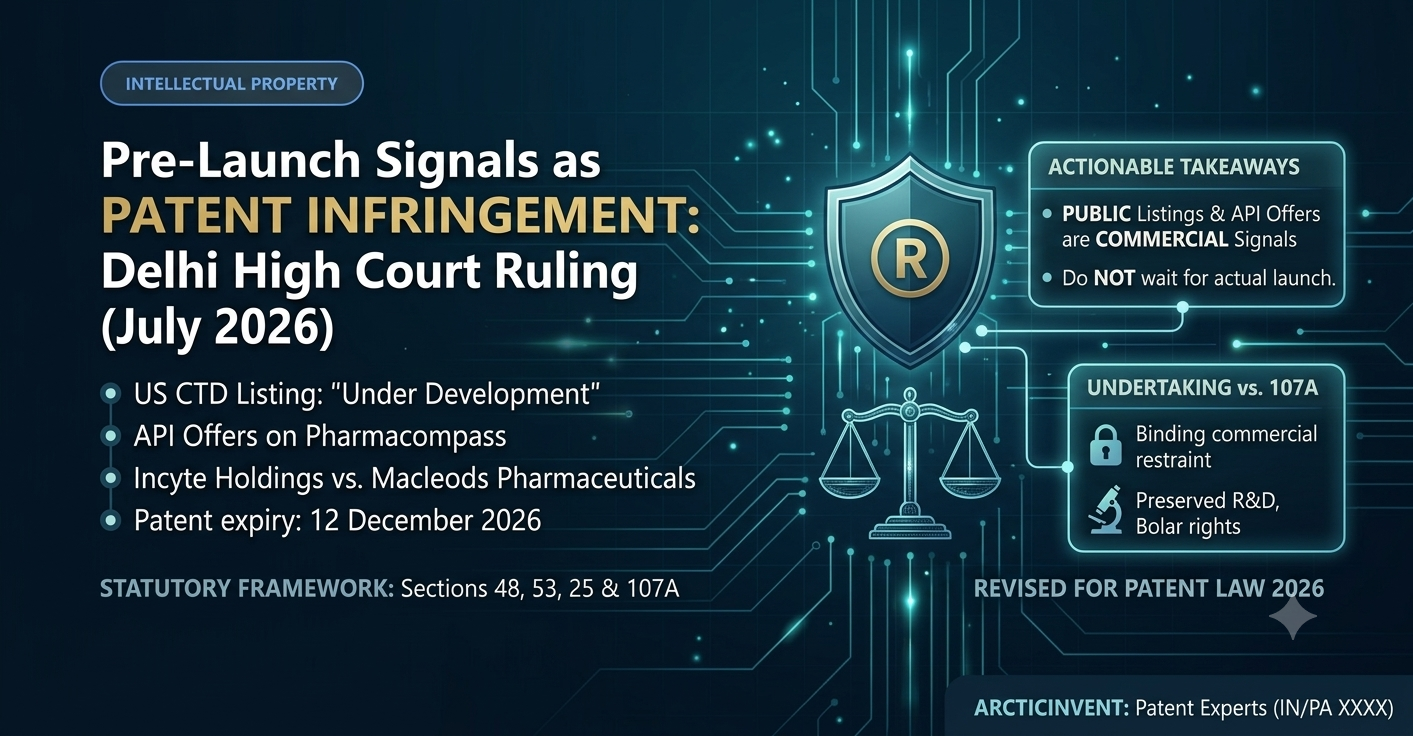
The most expensive patent war a founder ever fights is the one a competitor quietly wages years before launch. On 27 July 2026, the Delhi High Court accepted a binding voluntary undertaking from Macleods Pharmaceuticals Ltd. that shut down its commercial Ruxolitinib programme without a single day of contested trial, demonstrating that even pre-launch signals a product listed as "Under Development" on a publicly searchable US regulatory database and an active pharmaceutical ingredient offered for sale on a global pharmaceutical marketplace are sufficient to trigger patent infringement liability under the Patents Act, 1970.
For Indian IP holders, generic manufacturers, patent agents and founders, the case delivers a single, actionable lesson: do not wait for a competitor to launch your patented product before acting. Early signals are actionable. And the courts, at least the Delhi High Court exercising CS(COMM) jurisdiction, are willing to dispose of an infringement suit on the strength of a clean, time-bound undertaking rather than put the parties through years of contested litigation.
Background: Incyte, Patent No. 269841, and Ruxolitinib
Incyte Holdings Corporation is the innovator behind Ruxolitinib, the breakthrough JAK1/JAK2 inhibitor approved globally for myelofibrosis and polycythemia vera two serious, often debilitating blood disorders. In India, Incyte holds Patent No. 269841 covering the compound itself. Nothing about that patent has ever been contested. No pre-grant representation under Section 25(1) of the Patents Act was ever filed; no post-grant opposition under Section 25(2) was ever filed; and no revocation petition was ever filed. The patent had stood uncontested for 19 years going into the order, with expiry set for 12 December 2026.
Macleods Pharmaceuticals Ltd., one of India's larger generic manufacturers, was not, at the time of the suit, selling finished Ruxolitinib tablets in any market. It was doing something quieter. Macleods had listed Ruxolitinib products in its US CTD Product List as "Under Development" and was offering the API commercially on Pharmacompass, a well-known pharmaceutical business-to-business marketplace. Incyte read those acts as precursors to commercial infringement and filed CS(COMM) 763/2026 before the Delhi High Court.
Why Incyte Sued Before Any Finished Dosage Form Shipped
The Patents Act, 1970 does not require an accused infringer to ship a finished dosage form before liability attaches. The exclusive rights of a patentee under Section 48 extend to making, using, offering for sale, selling, and importing the patented product. Read alongside the explanatory framework of Section 47, the long line of Delhi High Court decisions on preparatory acts confirms that commercial exploitation upstream of finished sale can ground an infringement action in India when it crosses the line from research into commercial signalling.
Two concrete data points gave Incyte an unusually strong evidentiary foundation. First, the US CTD Product List is filed with the United States FDA in a public regulatory record format it is not a private marketing plan and it is not confidential. A listing on that database is discoverable, time-stamped, and admissible in Indian proceedings. Second, Pharmacompass is a transactional marketplace. An API listed for sale there is offered commercially to any qualified buyer willing to place an order. Together, the two public records formed what Incyte's plaint described as a trackable paper trail demonstrating commercial intent.
Incyte's strategic decision was to sue at the preparatory stage rather than wait for an actual launch. A patent holder who waits for an actual sale often discovers that the launch has already saturated the market, that the infringer's defence has hardened, and that the window for injunctive relief has closed. Filing early, on publicly verifiable preparatory acts, gives the patent holder the strongest possible negotiating position before the question of validity or infringement is ever tested on the merits.
The Defendant's Strategic Move A Voluntary Undertaking
A 19-year-old patent that has survived every form of opposition the Patents Act permits is presumed valid under Section 13(1) read with the long-standing presumption of validity in Indian patent jurisprudence. The evidential weight an accused infringer must rebut is heavy, and the procedural burden of mounting a contested Section 25(2)-style revocation defence in the middle of an infringement suit is significant. Macleods chose not to bear it.
Instead, Macleods offered to file a voluntary undertaking before Justice Jyoti Singh. The undertaking committed the company not to manufacture, launch, import, export, or deal in any product containing Ruxolitinib for the remaining term of the patent through 12 December 2026. Crucially, the undertaking did not extend to research. Macleods retained the right to continue studying the compound, validating bioequivalence, preparing its generic dossier, and positioning itself for a launch the moment the patent expired.
For Macleods, the undertaking was a commercial calculation rather than a legal defeat. A binding undertaking disposed of the suit without a contested judgment on infringement, without a permanent injunction on Macleods' record, and without the discovery cost of a full trial. The price was restraint for the remaining four and a half months or 138 days of the patent term, a short and predictable commercial window. After 12 December 2026, Macleods is free to launch.
What the Court Held and Why It Matters
Justice Jyoti Singh accepted the undertaking and disposed of CS(COMM) 763/2026 on 27 July 2026. Three features of the order are worth noting for future strategy.
First, the order recorded the 19-year uncontested status of Patent No. 269841 as a relevant factor. A patent that has stood for nineteen years without challenge carries evidentiary weight even where validity is not formally adjudicated, and the court read that long uncontested record into the assessment of whether the undertaking was sufficient. Second, the court accepted the undertaking as a substitute for injunction rather than as a confession of infringement an important procedural distinction that protects Macleods' posture in any future, post-expiry commercial dispute. Third, and most strategically, the order expressly preserved Macleods' statutory rights under Section 107A of the Patents Act, ensuring that the undertaking cannot be read to constrain legitimate research, bioequivalence studies, ANDA / CTD preparation work, or any regulatory activity reasonably related to seeking marketing approval.
The order did not break new law. What it confirms is that the Delhi High Court, as the principal forum for pharmaceutical patent litigation in India, will treat a clear time-bound undertaking as a complete disposition in an infringement suit where the patent is presumed valid, the alleged preparatory acts are publicly documented, and the defendant's research carve-out is cleanly preserved.
Section 107A Why the Carve-out Is Strategically Essential
Section 107A of the Patents Act, 1970 was introduced by the Patents (Amendment) Act, 2005 specifically to bring India's regime into conformity with TRIPS Article 30. The provision exempts the use of a patented invention "for the purposes of research and development" from the scope of infringement under Section 48, including activities reasonably related to seeking marketing approval. Indian courts have repeatedly held that Section 107A is a carve-out not a defence to a properly pleaded infringement claim but it is a carve-out that defines, in advance, what does not count as infringing use.
For a generic manufacturer, the practical effect is substantial. A company can experiment with a patented compound, run bioequivalence studies, prepare its dossier, and file its application with the relevant drug regulator during the patent term, without that activity being treated as infringement. That is exactly what Incyte v. Macleods preserved. The undertaking bound Macleods only as to commercial acts. Research continued untouched.
What Founders and Patent Holders Should Take Away
If you hold a granted Indian patent on a commercially valuable compound, do not wait for the actual launch. Incyte v. Macleods shows three practical moves worth standardising into your IP monitoring workflow.
First, monitor publicly verifiable signals US FDA filings and DMF submissions, ANDA tentative approval listings, regulatory product lists in target export markets, and transactional pharmaceutical marketplaces at quarterly cadence. A listing that says "Under Development" is not legally harmless, and a public-facing API offer is not private. Second, when you spot such a signal, send a notice. A formal cease-and-desist supported by the patent number, the listing URL or screenshot, and a draft undertaking costs a fraction of a suit and often produces the same commercial result. Third, if a notice does not produce a clean undertaking, file. CS(COMM) jurisdiction in the Delhi High Court accepts plaint-side applications based on preparatory acts, and the procedural pathway from filing to a binding undertaking on consent is comparatively fast.
What Generic Manufacturers Should Take Away
The other half of this case is the warning. Listing a patented API for sale on a public marketplace is not research. It is commercial signalling. So is filing a regulatory database entry that names a patented compound as part of an active commercial pipeline. Section 107A protects your bench. It does not protect your business-development pipeline.
If you intend to launch at patent expiry, build your dossier and your bioequivalence data strictly within the Section 107A envelope. Do not advertise your API for sale to commercial buyers. Do not file CTD entries marked "Under Development" in foreign regulators' public databases. Do not respond to inbound commercial enquiries with pricing commitments. Where a foreign regulatory filing necessarily names the compound, ensure the entry is technically framed as research-stage and is internally documented as such. Incyte v. Macleods makes clear that the court will read what the public record actually says, not what the company privately characterised.
Frequently Asked Questions
Does listing a patented product as "Under Development" count as patent infringement in India?
Yes, in many circumstances. The Patents Act, 1970 defines the exclusive rights of a patentee under Section 48 to include offering for sale and commercial use. A public regulatory listing that names a patented compound as part of an active commercial pipeline can be characterised as a preparatory act of infringement, particularly when the patent is presumed valid and no Section 107A research justification appears on the record. In Incyte v. Macleods (Delhi HC, 27 July 2026), the court treated the US CTD Product List and the Pharmacompass API offering as commercially actionable preparatory acts.
Is selling an active pharmaceutical ingredient (API) online considered patent infringement?
Yes, it can be. Offering a patented API for sale on a public marketplace is an act of commercial exploitation that the patent holder has not authorised. Where the API is the compound claimed in the granted claims of the patent, the offer for sale can ground infringement liability under the Patents Act, 1970. Section 107A research protection does not cover commercial offers. A prior commercial use defence rarely succeeds for an API that has only ever been lawfully sold by the patent holder.
What is a voluntary undertaking in patent litigation?
A voluntary undertaking is a written commitment filed by an accused infringer with the court, promising specified restraint typically not to manufacture, sell, import, export, or deal in the patented product for a defined period. Once the court records the undertaking, the suit is disposed of on its basis. The accused infringer avoids a contested judgment on infringement; the patent holder avoids the cost, delay, and evidentiary risk of trial. The undertaking is binding on the undertaking party and is enforceable as an order of the court.
How does Section 107A protect generic drug manufacturers?
Section 107A of the Patents Act, 1970, introduced by the 2005 amendment, exempts acts done "for the purposes of research and development" from infringement liability under Section 48. Indian courts have read this to include regulatory research reasonably related to seeking marketing approval, including bioequivalence studies, formulation development, and dossier preparation. Section 107A is not a general experimental-use defence it does not protect generic selling during the patent term but it is the principal statutory foundation for what is internationally known as the Bolar exception.
Can a patent that has stood nineteen years uncontested be assumed valid in litigation?
Yes, with confidence. Under the Patents Act, 1970 and established Indian jurisprudence, a granted patent is presumed valid. The presumption is rebuttable, but the evidential weight of an unchallenged patent is significant. A patent that has stood for nineteen years without pre-grant representation, post-grant opposition, or revocation petition carries particularly strong evidentiary force. In Incyte v. Macleods, the court's order expressly referenced this long uncontested record as a relevant factor in accepting the undertaking.
Could Macleods have launched Ruxolitinib after 12 December 2026 under the same order?
Yes. The voluntary undertaking was expressly time-bound to the validity of Patent No. 269841, which expired on 12 December 2026. From 13 December 2026 onwards, the undertaking ceased to bind Macleods, and the company was free to manufacture, launch, and sell Ruxolitinib products subject to ordinary regulatory approval under the Drugs and Cosmetics Act, 1940 and any applicable bioequivalence / bioassay requirements of the Central Drugs Standard Control Organisation.
Glossary of Key Terms and Statutes
Section 107A, Patents Act, 1970 The statutory carve-out that exempts the use of a patented invention for research and development purposes, including activities reasonably related to seeking marketing approval, from the scope of infringement under Section 48. Often described as India's Bolar exception, introduced by the Patents (Amendment) Act, 2005 to bring the regime into conformity with TRIPS Article 30.
Active Pharmaceutical Ingredient (API) The biologically active component of a finished pharmaceutical dosage form. In Incyte v. Macleods, the API at the centre of the dispute was Ruxolitinib, the compound protected by Indian Patent No. 269841.
US CTD Product List A public regulatory submission filed with the United States Food and Drug Administration in the Common Technical Document format. The list identifies products a manufacturer intends to develop for the US market and is publicly searchable. A listing marked "Under Development" is treated by Indian courts as evidence of commercial intent, not research-stage preparation.
Voluntary undertaking A written commitment filed by a party in pending litigation, promising specified future conduct, that the court records as an order. Once accepted, it is enforceable in the same manner as any other court order. In patent infringement matters, voluntary undertakings commonly substitute for injunctions.
Section 25, Patents Act, 1970 The statutory provision governing pre-grant representation (Section 25(1)) and post-grant opposition (Section 25(2)). The absence of any action under either sub-section for nineteen years was a contributing factor to the court's assessment of Patent No. 269841's presumed validity in Incyte v. Macleods.
Section 53, Patents Act, 1970 The provision governing the term of every patent in India: twenty years from the date of filing of the application, subject to annual renewal via Form 21 annuity payments. Patent No. 269841 expires 12 December 2026.
CS(COMM) jurisdiction, Delhi High Court The commercial suit jurisdiction of the Delhi High Court handling matters valued above the pecuniary threshold prescribed under the Commercial Courts Act, 2015, including patent infringement suits. CS(COMM) cases are typically presided over by designated commercial division judges and follow the timelines prescribed under the Commercial Courts Act.