How Intellectual Property Rights Power Economic Development
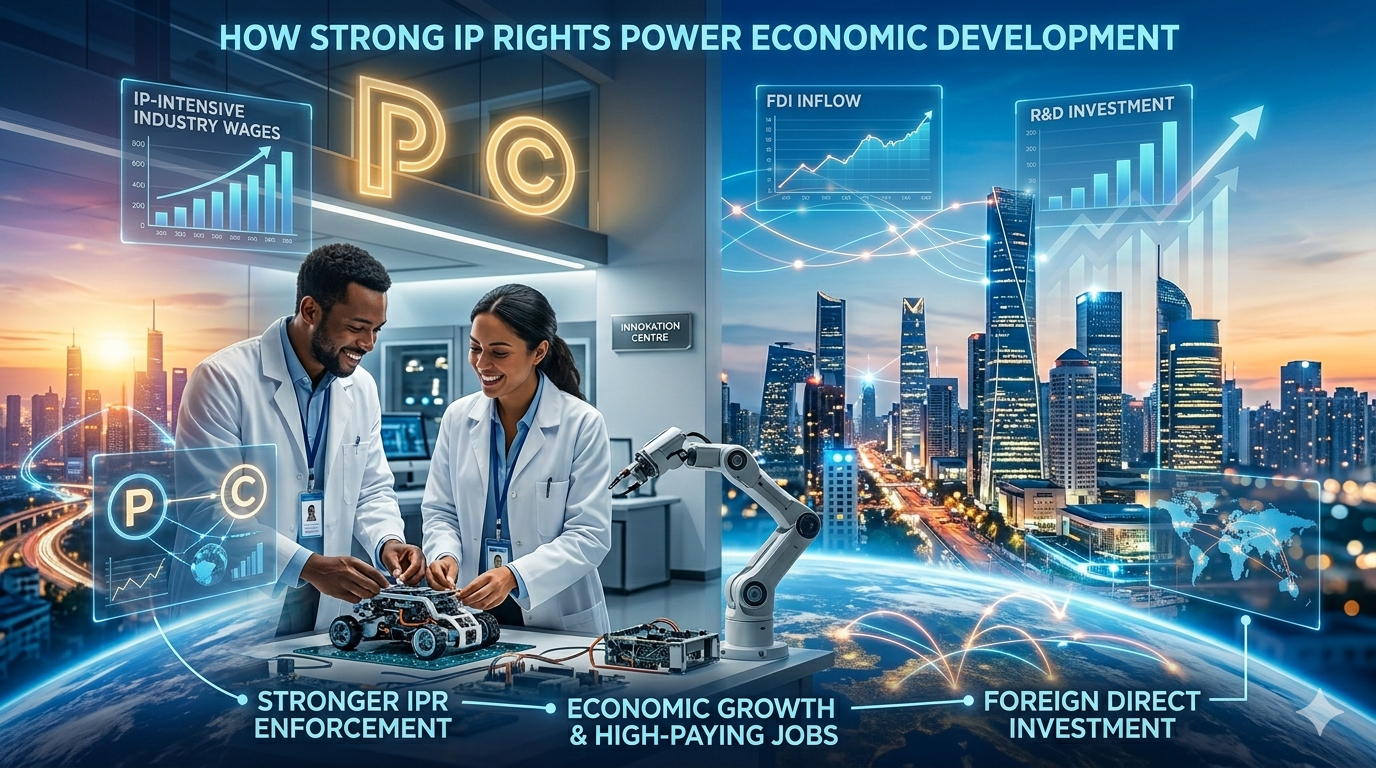
How Intellectual Property Rights Power Economic Development
Ever wondered why some countries churn out game-changing inventions while others struggle to keep innovators from packing their bags? The answer often comes down to one thing: how seriously a nation treats intellectual property rights in economic development.
When creators know their ideas are safe, they build. When they don't, they hold back — or leave. That single shift changes everything: jobs, foreign investment, tax revenue, exports, and a country's place in the global innovation race.
This post breaks down exactly how IP rights fuel economies, why enforcement matters more than the laws themselves, and what happens when protection slips. Whether you're an inventor, a founder, or just curious about the invisible engine behind modern growth, you'll walk away understanding why strong IP isn't just legal paperwork — it's economic infrastructure.
What Intellectual Property Rights Really Mean
Intellectual property rights are legal protections for things your mind creates — inventions, brand names, creative works, designs, and confidential business know-how. Think of them as fences around ideas. Without those fences, anyone can walk in and take what you built.
At their core, IP rights do three things:
- Give creators exclusive control over how their work is used, sold, or licensed for a specified period.
- Reward investment in research, design, branding, and creative effort.
- Enable trade by making ideas transferable assets — something you can sell, license, or use as collateral.
This isn't just abstract theory. A patent on a new medical device, a trademark on a coffee shop logo, a copyright on a novel, a trade secret behind a beverage recipe — these are all examples of IP working as property. Just like owning land or a building, but for ideas.
Here's what most people miss: IP isn't just about lawyers and filings. It's about turning intangible effort into tangible value. A software startup with 12 employees and no factory can be worth billions — because its IP is the asset. Entire industries, from pharmaceuticals to entertainment to consumer tech, are built on this foundation.
When a legal system recognizes and defends these rights, it signals something powerful: ideas matter here, and they'll be protected.
Why IP Rights Are an Economic Engine
Economies grow when people take risks — building new products, starting companies, investing capital. But risk-taking needs a potential payoff. IP rights help provide that payoff by ensuring the person or entity who invests time and capital has a legal framework to seek a reward.
The Innovation Feedback Loop
Strong IP creates a cycle that feeds itself:
- A creator invests time and money into a new idea.
- IP protection grants them exclusive rights to profit from it for a set period.
- Those profits can be reinvested into more research and more ideas.
- The broader ecosystem levels up as knowledge is eventually shared.
Research across global economies consistently shows a strong link between robust IP systems and higher GDP per capita, more patent filings, greater research and development spending, and higher rates of entrepreneurship. IP-intensive industries account for a disproportionate share of economic output in advanced economies — often contributing heavily to GDP and supporting a significant share of jobs.
Jobs That Pay More
Workers in IP-intensive sectors typically earn significantly more than workers in other industries. Why? Because their work is tied to high-value, protected output — the kind that can be sold globally, requires specialized skills, and creates unique market advantages.
This matters for policy, too. Countries that strengthen their IP systems tend to see upward shifts in workforce skill, tech transfer, and specialization. It's an effect that helps reshape and modernize labor markets.
The Four Pillars of IP Protection
Understanding how IP drives economies means understanding the different forms it takes. Each pillar protects something specific and plays a distinct role in the economy.
Patents
Patents protect inventions — new machines, processes, chemical compounds, or technical methods. They give inventors exclusive rights, typically for 20 years from the filing date, in exchange for publicly disclosing how the invention works. This trade-off is brilliant: inventors get temporary protection, and society gets the knowledge added to the public pool to build upon.
Trademarks
Trademarks protect brand identity — names, logos, slogans, and even sounds or colors that identify a commercial source. They do more than prevent knock-offs; they let consumers trust what they're buying and allow businesses to build reputation as an asset. A recognizable trademark can become one of the most valuable things a company owns.
Copyrights
Copyrights protect original creative works — books, music, films, software code, artwork, and more. Under international treaties like the Berne Convention, they arise automatically when a work is created and fixed in a tangible medium. Copyrights power entire industries: publishing, entertainment, software, and digital media.
Trade Secrets
Trade secrets protect confidential business information that provides a competitive edge — formulas, algorithms, customer lists, and manufacturing techniques. Unlike patents, they do not require public disclosure. They last as long as the secret is reasonably maintained and remains unknown to the public. For many businesses, this is the quiet powerhouse of their IP portfolio.
Why Enforcement Matters More Than Laws on Paper
Here's the uncomfortable truth: a country can have modern IP laws on the books and still struggle to attract innovators. Why? Because laws don't enforce themselves.
Enforcement is the muscle behind the paperwork. Without it, IP rights are just unfulfilled promises. Smart creators, investors, and multinational companies evaluate practical realities over theoretical laws.
What Real Enforcement Looks Like
- Functioning courts that hear IP cases within reasonable timeframes.
- Specialized IP judges or tribunals who understand complex technical matters.
- Customs enforcement that actively intercepts counterfeit goods at borders.
- Criminal penalties for commercial-scale piracy and counterfeiting.
- Meaningful damages — financial awards high enough to compensate the creator and deter repeat infringement.
- Administrative pathways for quick action against online infringement.
The Gap Between Law and Practice
Many economies have ratified international IP treaties — yet enforcement stays weak. Cases drag on for years. Damages are token. Counterfeits flood local markets. When this happens, foreign companies hesitate to license their best technology locally. Domestic inventors file fewer patents because the protection feels hollow.
Contrast this with jurisdictions where infringement cases are resolved efficiently and repeat offenders face real consequences. Investment flows in. Local innovators take bigger risks. The legal certainty itself becomes an economic asset.
IP Rights, Innovation, and Foreign Investment
Capital follows certainty. When investors — whether domestic venture funds or multinational corporations — evaluate where to allocate resources, the strength of local IP enforcement is a primary consideration.
Why Investors Care So Much
Imagine funding a biotech startup. The company's core value lies in a few patent applications. If those patents cannot be reliably defended in their operating markets, the investment is highly exposed. That's why strong IP regimes attract:
- Higher foreign direct investment (FDI) in knowledge-intensive sectors.
- More technology licensing deals from advanced economies.
- Joint ventures that involve transferring sophisticated manufacturing processes.
- R&D centers established by global companies in local markets.
Tech Transfer and Local Capacity
When global companies trust local IP protection, they are more willing to bring their best technologies across borders. Local engineers learn advanced methods. Suppliers upgrade their standards. Universities partner with industry on research that actually gets commercialized. Over time, the local economy builds its own innovation capacity instead of relying solely on imported goods.
The Real Cost of Weak IP Systems
When IP rights fail, the damage goes far beyond individual companies losing revenue. Entire economies pay the price.
Counterfeiting and the Shadow Economy
Global trade in counterfeit and pirated goods is estimated in the hundreds of billions of dollars annually. Beyond lost sales to legitimate businesses, counterfeits:
- Undermine tax revenue that could fund public services.
- Introduce unsafe products into the market — such as fake pharmaceuticals, defective electronics, or substandard automotive parts.
- Often fund organized crime networks.
- Negatively impact legitimate jobs in manufacturing and retail.
Brain Drain
Talented inventors and creators often relocate to jurisdictions where their work is legally and financially protected. This hollows out local innovation ecosystems. A country can invest heavily in educating brilliant engineers, only to watch them build their companies abroad where their IP holds actual value.
Lost Trade Relationships
Countries with chronically weak IP enforcement frequently face trade friction, higher tariffs on certain goods, or exclusion from trade agreements that prioritize strict IP standards. The short-term "savings" of loose enforcement are generally eclipsed by the long-term costs of a stalled innovation economy.
How Developing Economies Benefit from Strong IP
A persistent myth suggests that IP protection exclusively benefits wealthy nations while hurting developing ones. The reality is that strong, thoughtfully implemented IP systems can be powerful tools for economic development.
Protecting Local Innovation
Traditional knowledge, local crafts, regional food products, and domestic inventions all deserve protection. Geographical indications protect products tied to specific regions (like specific types of tea or coffee). Utility models offer lighter, faster protection for incremental innovations that matter deeply in emerging markets. These tools let local creators capture economic value that might otherwise be exploited abroad.
Building Knowledge-Based Sectors
Several emerging economies have transformed into serious tech and manufacturing hubs partly by modernizing their IP frameworks and specializing their courts. Establishing legal certainty helps domestic industries—such as software, engineering services, and pharmaceuticals—scale and compete globally.
Flexibility Within the System
International IP frameworks, such as the TRIPS Agreement, include deliberate flexibilities. Mechanisms like compulsory licensing for essential public health crises, exceptions for education and research, and phased implementation periods allow developing economies to balance the need to incentivize innovation with pressing public interest needs.
Modern Challenges: Digital Goods and Cross-Border IP
The IP systems most countries rely on were initially designed for physical goods and national borders. But modern innovation is increasingly digital, instantaneous, and global.
Piracy at the Speed of Light
A software product, film, or e-book can be copied infinitely and distributed worldwide in seconds. Traditional enforcement — raiding a warehouse or seizing physical goods — is ineffective when the infringing material is hosted on a server in one jurisdiction and streamed to users in another.
AI and Generative Content
Machine-learning systems trained on vast amounts of data are forcing a global legal rethink of what constitutes infringement, authorship, and fair use. Questions about who owns the output generated by AI, and whether training on protected works requires explicit permission, are currently being debated in courtrooms and legislatures worldwide.
Cross-Border Enforcement
A patent granted in one country does not automatically prevent infringement in another. While international treaties streamline the application process, enforcing rights across different jurisdictions remains complex and expensive. Strategic global filing and a clear understanding of international litigation realities have never been more important for businesses.
Building Stronger IP Systems
What does it take to build an IP system that actively drives economic growth? It requires a combination of legal, institutional, and cultural pillars.
Legal Foundations
- Modern, unambiguous IP laws aligned with international standards.
- Regular legislative updates to address emerging technologies.
- Balanced legal frameworks that reward original creators while allowing room for follow-on innovation.
Institutional Strength
- Well-funded, efficient patent and trademark offices with highly trained examiners.
- Specialized courts to handle complex IP litigation.
- Coordination between civil, criminal, and border enforcement agencies.
Access and Awareness
- Accessible filing processes that don't price out small businesses and individual inventors.
- Public education regarding how to identify, protect, and commercialize intellectual property.
Cultural Shift
IP protection functions best when a society respects it — when consumers actively choose legitimate products and businesses view avoiding infringement as an ethical standard, not just a legal hurdle. Building this culture takes time, starting with education and visible support for local creators.
Frequently Asked Questions
How do intellectual property rights contribute to economic development?
IP rights drive development by providing creators with exclusive commercial control over their inventions and brands for a set time. This legal certainty encourages investment in research and development, supports high-paying jobs, attracts foreign direct investment, and helps transition economies toward knowledge-intensive industries.
Why is enforcement of IP laws more important than having the laws themselves?
Laws without robust enforcement offer no practical protection. Creators and investors evaluate real-world outcomes. If infringement cases take years to resolve or result in minimal financial penalties, the protection is merely theoretical. Fast courts, meaningful penalties, and active customs enforcement are what actually deter infringement and build market trust.
Do IP rights hurt developing economies?
When implemented with appropriate balance, they do not. Strong IP systems help developing economies protect indigenous innovations, attract higher-quality foreign investment, and develop local tech sectors. International agreements also provide flexibilities—such as compulsory licensing—to ensure countries can manage public health and developmental priorities alongside IP enforcement.
What happens to a country's economy when IP rights are weak?
Chronically weak IP systems can lead to a reduction in foreign investment, the migration of top talent to safer jurisdictions (brain drain), lost tax revenues, and the proliferation of unsafe counterfeit goods. It also creates a chilling effect on local entrepreneurship, pushing businesses toward low-risk, imitative models rather than genuine innovation.
Which types of IP rights matter most for economic growth?
All four major types—patents, trademarks, copyrights, and trade secrets—play vital, complementary roles. Patents drive deep technology and scientific advancements. Trademarks build consumer trust and corporate value. Copyrights sustain the creative, media, and software industries. Trade secrets protect the operational and strategic advantages of businesses across all sectors.
How does IP protection affect foreign direct investment (FDI)?
IP strength is a major deciding factor for multinational corporations. Companies are significantly more likely to transfer advanced technology, build R&D facilities, and establish joint ventures in nations where their proprietary knowledge is legally secure. Strengthening IP enforcement is consistently linked to increases in high-value FDI.
Intellectual property rights aren't just legal paperwork — they're the foundation upon which modern economies are built. When creators and businesses trust that their work is legally secure, they invest, experiment, and scale. When that trust breaks down, innovation stalls, and economic growth is left on the table. Strengthening IP isn't just about protecting the ideas of the past; it's about financing the breakthroughs of the future.