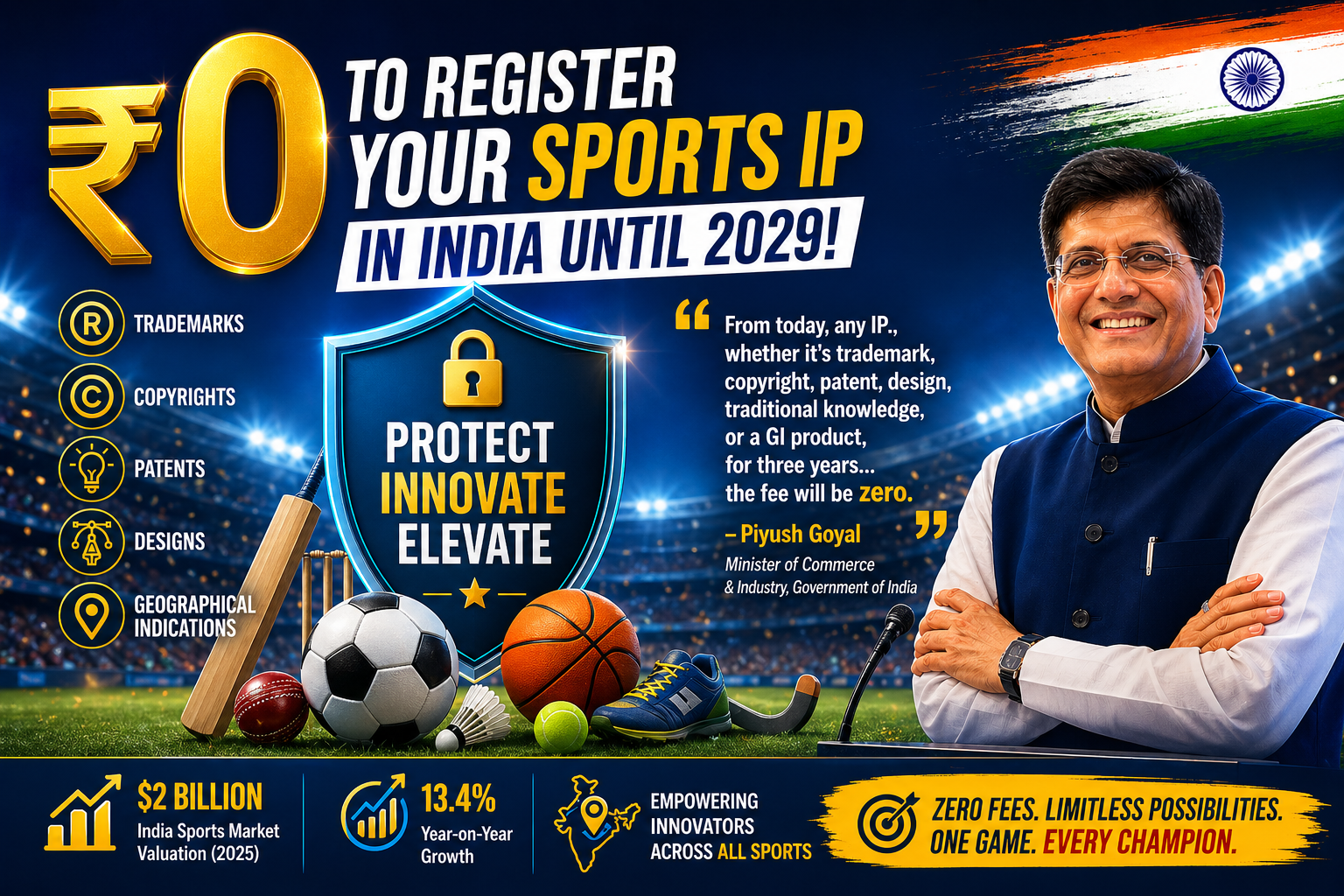
A major shift in the intellectual property framework was announced during the World IP Day 2026 celebrations. The Government of India has introduced a three-year period where all application fees for intellectual property rights in the sports sector are set to zero. This move is intended to support the domestic manufacturing of sports goods and encourage new technical ideas within the industry.
The policy applies to a wide range of protections. These include trademarks, copyrights, patents, designs, traditional knowledge, and Geographical Indications. The initiative follows the theme of 'IP and Sports: Ready, Set, Innovate!' and reflects a specific focus on the growing economic weight of the sports market in India.
Fee waiver for sports IP lasts until 2029
The zero-fee drive is scheduled to remain in effect for three years from its start date. This means that businesses, innovators, and students can file applications without the usual financial burden of registration fees. The Office of the Controller General of Patents, Designs and Trade Marks (CGPDTM) is the body responsible for issuing the formal notification that operationalizes this waiver.
The following statement was made during the official announcement event: "From today, any IP, whether it's trademark, copyright, patent, design, traditional knowledge, or a GI product, for three years, as a special drive to promote sports, the fee will be zero." This statement clarifies that the waiver is a broad measure covering every major category of intellectual property. The Department for Promotion of Industry and Internal Trade (DPIIT) is tasked with the implementation and support of this policy.
- Registration fees for patents are waived for three years.
- Trademark and copyright filing costs are reduced to zero.
- Geographical Indications and traditional knowledge entries are included.
Market value reached 2 billion USD in 2025
The introduction of this policy comes at a time when the sports market in India is seeing rapid expansion. In 2025, the industry valuation surpassed 2 billion USD, which is approximately 18,864 crore INR. This financial milestone indicates that the sector is no longer just a pastime but a significant economic driver for the country.
The growth rate recorded in 2025 was 13.4% compared to the previous year. This steady increase suggests that the demand for sports equipment, apparel, and media content is rising. The 13.4% year-on-year growth demonstrates the potential for businesses to scale if they protect their original ideas and brand identities early. This fee waiver serves as a tool to help smaller entities secure their place in this growing market without upfront legal costs.
Cricket accounts for 89 percent of industry revenue
Data from 2025 shows a heavy concentration of revenue within a single sport. Cricket is responsible for 89% of the total industry income in India. This dominance affects how intellectual property is used, particularly regarding media rights, player branding, and franchise logos. The policy encourages sports leagues to register their trademarks to build up their franchising potential and secure better media rights deals.
While cricket leads the market, the zero-fee policy is designed to help other sports catch up. By removing the cost of entry for IP registration, the government aims to see a rise in innovation across football, kabaddi, and athletics. The fact that cricket holds 89% of the market suggests there is significant room for growth in other sports categories as they begin to utilize intellectual property protections more effectively.
Zero-fee protection for six IP categories
The scope of the waiver is defined by six specific types of intellectual property. This ensures that every aspect of a sports business is covered, from the invention of a new high-performance shoe to the logo of a local team. The policy is integrated with the existing legal framework in India, including the Patents Act and the Trade Marks Act.
- Patents: Covers new inventions in sports technology and equipment.
- Trade Marks: Protects team names, logos, and brand slogans.
- Designs: Covers the unique visual appearance of sports gear and apparel.
- Copyright: Protects broadcast content, media rights, and promotional materials.
- Geographical Indications: Protects products tied to specific regions, such as Meerut bats.
- Traditional Knowledge: Protects ancient sports practices and indigenous methods.
The policy covers trademarks, copyrights, patents, designs, traditional knowledge, and Geographical Indications to provide a full legal shield for sports businesses. Support is also available through existing government schemes to help students and artisans navigate the filing process. This ensures that the technicalities of the law do not prevent creators from securing their rights.
New manufacturing clusters in Meerut and Jammu & Kashmir
A key part of the policy involves the physical production of sports goods. There is a focused effort to develop sports manufacturing clusters in specific regions, namely Meerut and Jammu & Kashmir. These areas are already known for producing sports equipment, and the new IP policy aims to help these local manufacturers move from generic production to branded, protected innovation.
By registering designs and patents for their products, local manufacturers can compete on a global scale. The government will provide facilitation support to help these regional hubs understand how to use the three-year waiver. The plan to develop clusters in Jammu & Kashmir and Meerut is tied to the goal of increasing domestic manufacturing and reducing reliance on imports for high-end sports equipment.
The effectiveness of this three-year fee waiver is scheduled for a formal review once the period ends. This re-evaluation will determine if the policy has led to a measurable increase in IP filings and innovation within the Indian sports industry.
Legal references explained
Patents Act (India)This Act provides the legal framework for protecting new and inventive technical solutions. In the sports sector, it is used to secure rights for innovative equipment, such as advanced ball designs or protective gear technology.
Trade Marks Act (India)This legislation governs the registration of brand names, logos, and symbols. It allows sports teams and equipment manufacturers to distinguish their goods and services from those of competitors.
Designs Act (India)This Act protects the aesthetic and visual features of a product. It is often applied to the unique shape, pattern, or configuration of sports apparel and footwear.
Copyright Act (India)This law protects original literary, artistic, and musical works. In sports, it is the primary tool for securing media rights, broadcast footage, and promotional content.
Geographical Indication (India)This protection is granted to products that have a specific geographical origin and possess qualities or a reputation due to that place. It is used to protect regional specialties like Meerut-made cricket bats.