State-Wise IP Reimbursement Schemes in India (2026)
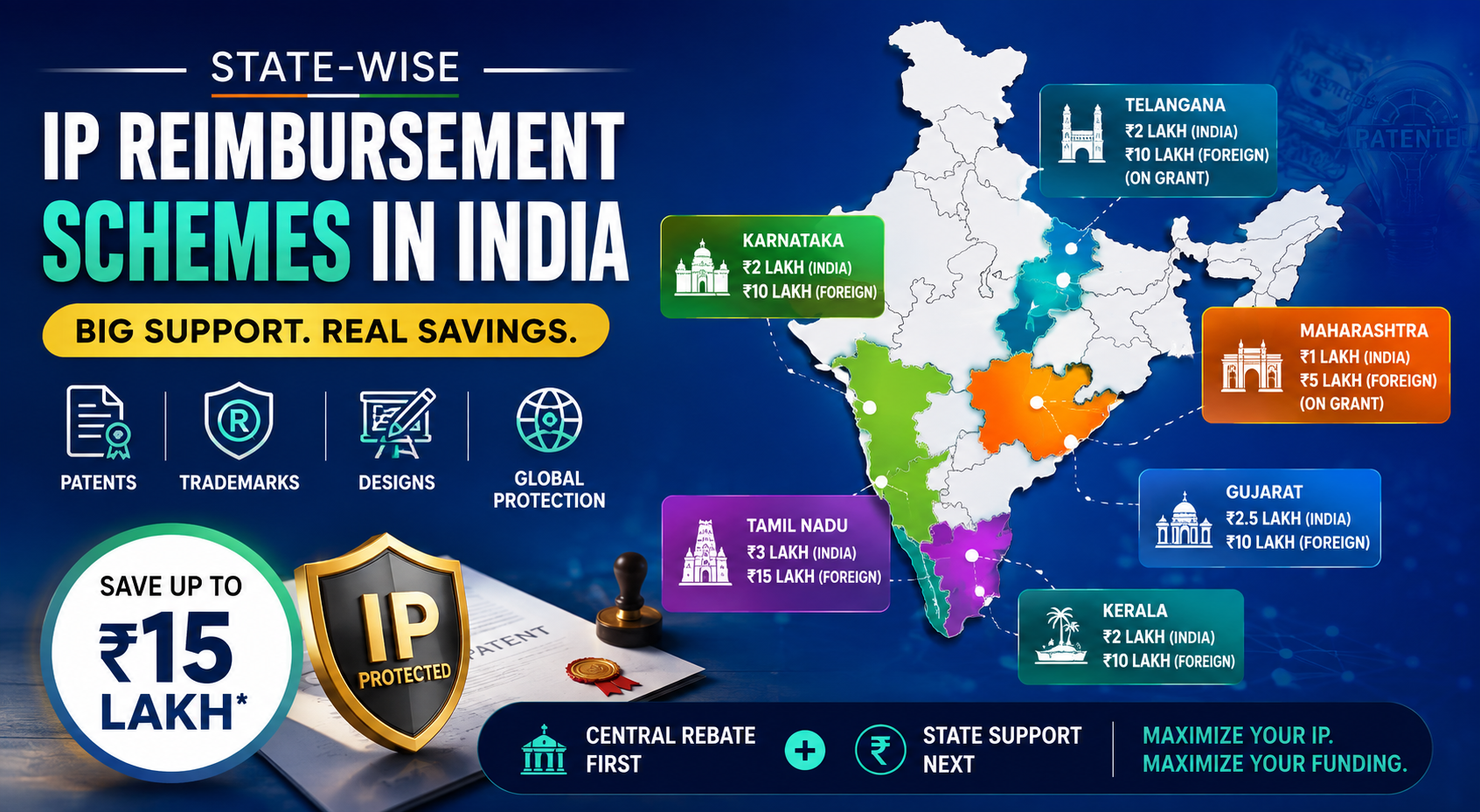
State-Wise IP Reimbursement Schemes in India (2026)
For startups, MSMEs, and independent inventors, the cost of protecting intellectual property quickly adds up—patent drafting, filing, examination requests, international filings under the Patent Cooperation Treaty (PCT), trademark registration across multiple Nice classes, and design protection under the Designs Act, 2000. Beyond the central government support available to DPIIT-recognised startups and recognised educational institutions under Patents (Amendment) Rules, 2024, at least six Indian states now run their own financial-assistance schemes that reimburse part of these costs—and several of these state-level schemes are larger than anything the Centre offers.
A startup founder who only checks central schemes can leave a meaningful slice of recoverable IP cost on the table. The Patents Act, 1970 enacted over five decades ago, in 1970 governs the underlying rights, and the fee and form structure sitting beneath every filing comes from the Patents Rules, 2003 as amended. The reimbursement side is administered by state innovation bodies, industry-facing departments, and state MSME directorates, each on its own operative notification.
This post walks through the headline figures of six state schemes, separates the four structurally distinct kinds of state IP support, and flags the eligibility edge cases most founders discover only after the fact.
Why State-Level Schemes Sit Between the Centre and You
Patent costs in India are set by the First Schedule of the Patents Rules, 2003 as amended—most recently notified on 15 March 2024 under the Patents (Amendment) Rules, 2024—and the fee schedule governs forms from Form 1 to Form 32 listed in the Second Schedule of the Patents Rules, 2003 as amended. The central government softens that cost for natural persons, DPIIT-recognised startups, and small entities via a structured rebate tier, and recognised educational institutions established by a Central, State, or Provincial Act (read with Rule 6 of the Patents Rules as substituted by the Patents (Amendment) Rules, 2016) get a separate rebate. State schemes sit on top of that central rebate.
The right way to read a state's scheme is not "either central or state" but "central first, state second". A first claim under the central rebate always runs first; the state-level sum typically reimburses the residual cost the founder has actually paid net of any central rebate already received. Treating the two as interchangeable double-counts the support.
Founders operating across more than one state are worth flagging. Several state schemes require the applicant's registered office inside the state, while a smaller subset asks only for incorporation under the Companies Act, 2013 or the LLP Act, 2008. Where both conditions apply, the operative test is the registered office at the date of patent filing—not where the inventor personally lives.
Karnataka — ₹2 Lakh (India) / ₹10 Lakh (Foreign) Patent Reimbursement
Karnataka's headline caps are ₹2 lakh for an Indian patent and ₹10 lakh for a foreign patent, with the disbursement tied to two operational milestones: an instalment linked to the patent filing on Form 1 under Section 7 of the Patents Act, 1970, and a second instalment on grant. The Karnataka Innovation and Technology Society (KITS), operating through the Karnataka Startup Cell (see also Startup India — Karnataka Policy), is the primary implementing body for startup reimbursement claims. For applicants that do not fall within the DPIIT-recognised startup definition, the Karnataka State Council for Science and Technology (KSCST) continues to administer the related R&D-track support.
Eligibility follows the standard Karnataka startup and MSME conditions: a startup recognised under the DPIIT framework, an MSME registered on the Udyam portal, or an individual inventor ordinarily resident in the state. The foreign patent arm covers PCT national-phase entry and direct foreign filings, capped at ₹10 lakh per granted patent.
Telangana — ₹2 Lakh (India) / ₹10 Lakh (Awarded Foreign) Patent Reimbursement
Telangana's scheme runs under the Telangana State Innovation Cell (TSIC) (see also Startup India — Telangana Policy) and the state's industry-facing policy framework, alongside MSME incentive tracks such as T-IDEA. Patent registration expenses are reimbursable up to ₹2 lakh for Indian patents and up to ₹10 lakh for foreign patents, the foreign-leg conditional on the foreign patent having been granted—not merely filed. Telangana and Maharashtra both enforce a strict post-grant / post-registration disbursement requirement on international claims; Telangana is not unique on this point. The Maharashtra State Innovation Society (MSInS) applies the same grant-conditional structure to its international arm, treating grant as the disbursement trigger rather than the filing of the application. Founders expecting reimbursement at the international filing stage are paid only on grant under both schemes.
Eligible applicants are DPIIT-recognised startups with a Telangana-registered entity, plus MSMEs and individual inventors ordinarily resident in the state. Reimbursement covers patents filed and prosecuted through a registered patent agent.
Maharashtra — State Innovation Society's IPR Scheme
Maharashtra operates its scheme under the Maharashtra State Innovation Society (MSInS), set up under the state's innovation and startup framework (details via Startup India — Maharashtra Policy). The scheme covers patents, designs, trademarks, and certain copyrights (software and artistic works registered under the Copyright Act, 1957 read with the Copyright Rules, 2013). Caps are ₹2 lakh for domestic IP and ₹10 lakh for international IP. The coverage is meaningfully broader than the patent-only Karnataka and Telangana schemes, and a design owner will find Maharashtra's route one of the few state-specific paths that explicitly reimburses design registration under the Designs Act, 2000. As noted in the Telangana section, MSInS disburses the international-leg reimbursement only after the foreign patent has actually been granted, not at the international filing stage.
Trademark reimbursement up to the ₹2 lakh cap is likewise available where the mark is filed across multiple Nice classes and the cumulative cost pushes past the schedule.
Uttar Pradesh — ₹2 Lakh / ₹10 Lakh Patent Support
Uttar Pradesh brings eligible startups within the same headline range as Karnataka, Telangana, and Maharashtra—up to ₹2 lakh for an Indian patent and up to ₹10 lakh for an international patent. The state disburses through the UP State Industrial Development Authority (UPSIDA) and the state startup mission via StartinUP — Official Patent Support Portal. Eligibility tracks the DPIIT-recognised startup framework plus UP-registered MSMEs and individual inventors ordinarily resident in the state. UP's scheme reads more consistently than some neighbouring schemes because its operative policy publication and amendment cycle is well documented.
Madhya Pradesh and Odisha Higher Caps Up to ₹5 Lakh
Two states push above the ₹2 lakh floor.
Madhya Pradesh, under the MP Startup Policy 2022, provides patent assistance up to ₹5 lakh. The state's Department of Science and Technology and the MP Startup Centre (cross-referenced on Startup India — Madhya Pradesh Policy) are the operative points of contact. Unlike the four states with a dual Indian/foreign cap, MP's ₹5 lakh figure is a single ceiling on assistance per Indian patent filing.
Odisha, under the state's MSME Development Policy, provides 100% assistance towards patent and IPR registration costs—a different formula from any of the other five. Official frameworks are outlined under Startup India — Odisha Policy and NITI for States — Odisha Policy Viewer. The same policy provides separate trademark assistance, with the cumulative IP assistance capped up to ₹5 lakh per applicant. "100% assistance" reads cleanly only after applying the ₹5 lakh ceiling: a founder with a patent whose total disbursable cost exceeds ₹5 lakh pays the excess. The phrase should not be read as unlimited.
Both MP and Odisha schemes are tied to MSME/Udyam registration of the applicant and to the founder's operational footprint in the state.
Filing Assistance vs Reimbursement After Grant vs Prosecution Costs vs Broader IPR Support
This is the section most state-level guides skip, and it is the most consequential. State IP support falls into four structurally different buckets, and confusing one bucket with another is the single largest reason published "guides" contradict each other.
- Filing assistance is paid when the application is filed. It typically reimburses Form 1 filing fees and a part of the agent's drafting charge up to the cap, and it does not require grant. The first instalment of many state schemes is a filing assistance.
- Reimbursement after grant is paid only when the patent register shows the patent has been granted by the Indian Patent Office. Telangana and Maharashtra (MSInS) both gate their foreign-leg claims behind grant; several other state schemes split into a filing instalment and a grant instalment on the domestic side.
- Reimbursement of prosecution costs covers the intermediate expenses between filing and grant: the examination request on Form 18 under Section 11B read with Rule 24B of the Patents Rules, 2003 as amended (note correctly: Form 18 is the request for examination, not Form 9, which is the request for early publication under Rule 24A); office-action responses; hearing attendance; and patent renewal fees paid online under Rule 80. Patent renewals are not "Form 21". Form 21 is the application for termination of a compulsory licence, filed under Section 94 read with Rule 102(1) of the Patents Act, 1970 and the Patents Rules, 2003 respectively, and is structurally unrelated to renewals.
- Broader IPR support covers patents, designs, trademarks, and copyrights together. Maharashtra's MSInS scheme is the only one of the six that straddles all four. The other five are patent-centric in their headline caps, with trademark or design elements only as carve-outs.
A claim filed under the wrong bucket is rejected on a documentary basis even when the substantive cost is otherwise reimbursable. Always check which bucket each state's cap and conditions live under before filing the claim.
How to Claim a State IP Reimbursement
- Confirm Eligibility: Confirm that the applicant at the date of filing matches the eligibility profile—DPIIT recognition extant, Udyam registration current, or ordinarily-resident individual inventor. Eligibility is decided at filing, and a recognition that comes in mid-prosecution rarely backdates.
- Maintain Documentation: File and prosecute the patent through a registered patent agent and retain the complete paper trail: filing receipts on Form 1, the Form 5 declaration as to inventorship under Rule 13(6) of the Patents Rules, 2003 attached at the Form 1 filing moment, the examination request on Form 18, every Form 13 amendment filed under Section 57 of the Patents Act, 1970 read with Rule 81 of the Patents Rules, 2003, the office-action correspondence, and the grant certificate. Most claims fail on documentary gaps rather than on eligibility. Form 5 and Form 13 sit on adjacent lines of the paper trail but serve different statutory functions—the first attests to who the inventor is at filing, and the second amends the application or complete specification post-filing—and reimbursing agencies look for both.
- Submit the State Claim: File the state reimbursement claim with the operative agency—Karnataka Startup Cell (KITS), Telangana State Innovation Cell (TSIC), Maharashtra State Innovation Society (MSInS), StartinUP (Uttar Pradesh), the MP Startup Centre, or the Odisha MSME Directorate / Startup Odisha—along with the state's prescribed reimbursement application form, original receipts, and copies of the patent documents.
- Reconcile with Central Rebates: Reconcile the state claim with the central rebate. Most states require the applicant to declare any central rebate already received and reduce the state claim by that amount. The central rebate is structured under Rule 6 of the Patents Rules, 2003 (as substituted by Patents (Amendment) Rules, 2016), and the state rebate sits on top of that—not parallel to it.
Founders wanting a complete cost-vs-recovery picture before committing to a state-level filing can pair this sequence with the Patent Filing Cost in India 2026 framework blog.
Frequently Asked Questions About State IP Reimbursement Schemes in India
- Which Indian states currently offer patent reimbursement for startups?
- Six states run operative patent reimbursement schemes with publicly visible caps: Karnataka, Telangana, Maharashtra, Uttar Pradesh, Madhya Pradesh, and Odisha. Each scheme is run by a different implementing agency and each publishes a separate cap. State schemes are updated periodically, so the operative policy and cap should be re-confirmed against the latest notification before filing.
- Is state IP reimbursement taxable?
- Reimbursement of an expense the founder has actually incurred is generally treated as a reduction of cost rather than income, but the precise treatment depends on the founder's entity structure and the wording of the state notification. Founders with a Pvt Ltd or LLP should have their chartered accountant reconcile the receipt against the books before treating it as a non-taxable item.
- Can a startup claim IP reimbursement from more than one state at the same time?
- Only if the startup's registered office and operational footprint genuinely sit in more than one state, and even then each scheme is independently admissible on its own merits. In practice, the registered office at the date of filing decides which state is competent, and a second state claim is screened out unless the founder's principal place of business has migrated in writing before the claim is filed.
- Do state IP reimbursement schemes cover international PCT filings?
- Karnataka, Telangana, Maharashtra, and Uttar Pradesh explicitly extend to foreign patents, with caps up to ₹10 lakh. Madhya Pradesh and Odisha are largely domestic. PCT national-phase entry operates on the 31-month post-priority deadline under Rule 20(4)(a) of the Patents Rules, 2003—this deadline is rooted in the original Patents Rules, not the Patents (Amendment) Rules, 2024, and readers cross-referencing the 2024 amendments will not find the 31-month window there. The 31-month clock is the cleanest cost-extraction path under any of the four foreign-cap schemes; for the wider procedural walk-through, the Step-by-Step Guide to Patent Registration in India lays out the underlying route.
- What is the difference between patent filing assistance and patent reimbursement?
- Filing assistance is disbursed at or shortly after the Form 1 filing and does not require grant. Reimbursement after grant is disbursed when the patent is granted. Reimbursement of prosecution costs falls between the two. Treating the three as one pool almost always produces an inflated cap claim that the implementing agency rejects.
- Are MSME-registered firms eligible under all six state schemes?
- Udyam-registered MSMEs are within the eligibility envelope in all six states; DPIIT-recognised startups are within the envelope in five of the six with state-specific conditions. Schemes that frame eligibility by "registered office in the state" exclude out-of-state applicants even where a DPIIT recognition is held.
Key Terms Explained
- Patent reimbursement: A payment by a state government to the applicant of an actual cost incurred in filing, prosecuting, or maintaining a patent, subject to the state's cap and conditions.
- Reimbursement after grant: A sub-type where the disbursement is conditional on the patent having been granted. Used by Telangana's foreign-leg scheme and by MSInS (Maharashtra) on its international arm, and as a second instalment in several other domestic schemes.
- Prosecution cost: The intermediate expense between filing and grant: Form 18 examination request, Form 13 amendments under Section 57 / Rule 81, office-action responses, and hearing support. Distinct from patent renewal fees, which are annuity payments under Rule 80.
- Filing assistance: Disbursement paid at or shortly after Form 1 filing, before examination starts. Most state schemes treat this as the first instalment.
- DPIIT-recognised startup: A startup recognised under the Startup India framework by the Department for Promotion of Industry and Internal Trade. The recognition must be current at the date of patent filing.
- Udyam registration: The operative MSME registration on the official Udyam portal, replacing the older Udyog framework. The registration certificate names the applicant's NIC code and enterprise classification.
- PCT national phase: The 31-month post-priority window under Rule 20(4)(a) of the Patents Rules, 2003 within which a PCT applicant enters the Indian national phase. Any apparent attribution to the Patents (Amendment) Rules, 2024 is incorrect: the 31-month window sits in the original rule. Foreign filing licence, where applicable, is filed separately on Form 25 under Section 39 of the Patents Act, 1970.
- Form 5: The Declaration as to Inventorship, filed under Rule 13(6) of the Patents Rules, 2003 at the Form 1 filing moment. It is not a post-filing amendment form.
- Form 13: The application to amend a patent application or complete specification, filed under Section 57 of the Patents Act, 1970 read with Rule 81 of the Patents Rules, 2003. It is the only statutory route for amending the application or specification post-filing and is distinct from Form 5 (inventorship declaration) and Form 21 (termination of compulsory licence).
- Form 18: The request for examination under Section 11B read with Rule 24B of the Patents Rules, 2003 as amended. Form 18 is not the early publication request—that is Form 9 under Rule 24A.
- Form 21: The application for termination of a compulsory licence, filed under Section 94 read with Rule 102(1) of the Patents Act, 1970 and the Patents Rules, 2003 respectively. Structurally unrelated to patent renewals (which are paid annually under Rule 80).
- State Innovation Council / Society: The state-level body tasked with disbursing IP reimbursement. KITS / Karnataka Startup Cell (Karnataka), TSIC (Telangana), MSInS (Maharashtra), StartinUP (UP), the MP Startup Centre (MP), and the Odisha MSME Directorate / Startup Odisha sit on this template.
- First Schedule: The fee structure embedded in the Patents Rules, 2003 (as amended) that determines the central rebate tier and the per-form cost. State reimbursement sits on top of the First Schedule cost, not in lieu of it.
- Second Schedule: The form list embedded in the Patents Rules, 2003 (as amended), running from Form 1 through Form 32. The form list referenced by First-Schedule cost entries lives in the Second Schedule.