The Seismic Shift in UK AI & Software Patents: Goodbye Aerotel, Hello Duns Principles
The Seismic Shift in UK AI & Software Patents: Goodbye Aerotel, Hello Duns Principles
The UK patent landscape for Artificial Intelligence (AI) and computer-implemented inventions (CIIs) has experienced its biggest shakeup in two decades.
Following the landmark UK Supreme Court judgment in Emotional Perception AI Limited v Comptroller General of Patents, Designs and Trade Marks [2026] UKSC 3, the UK Intellectual Property Office (UKIPO) has issued immediate statutory guidance that completely rewrites how software and AI applications are searched and examined.
If you are developing software or AI architectures, the rules of the game have changed overnight. Here is what the new framework means for your intellectual property strategy.
The Core Change: Aligning the UK with Europe
For nearly twenty years, the UKIPO relied on the structured, four-step Aerotel test to determine whether software inventions were barred from patentability. The Supreme Court has officially thrown out Aerotel.
Instead, the UK is pivoting to align closely with the European Patent Office (EPO). Specifically, the UK has adopted the famous Duns principles (A to F) from EPO jurisprudence, influenced by the Enlarged Board of Appeal’s landmark G 1/19 decision. This framework firmly separates patent eligibility from novelty and inventive step, moving away from trying to find a "technical contribution" at the very first gate.
The New Three-Step Examination Framework
Under the new guidelines, patent examiners will review computer-implemented and AI inventions using a rebranded "two-hurdle approach" that actually unfolds in three strict sequential steps:
1.The First Hurdle: The 'Any Hardware' Test:Patent Eligibility.The examiner checks if the claim involves any physical or technical means. If your invention mentions a computer, a microprocessor, a network server, or a computer-readable storage medium, it automatically passes this hurdle. The old obstacle of proving an invention wasn't a computer program "as such" at the entry gate is gone.
2.The Intermediate Step: Technical Filtering:Identifying Technical Character.This is the new battleground. The examiner analyzes the claim feature-by-feature to isolate which elements contribute to the "technical character" of the invention viewed as a whole. A feature qualifies if it interacts with the system to provide a technical solution to a technical problem. Non-technical features that don't solve a technical problem are filtered out here.
3.The Second Hurdle: Novelty & Inventive Step:Prior Art Assessment.Finally, the examiner assesses whether the invention is new and non-obvious using standard UK case law (like the Pozzoli approach). However, there is a catch: the examiner will entirely ignore any non-technical features isolated in Step 2. If your invention’s only differences from the prior art are non-technical, the patent will be rejected for lack of an inventive step.
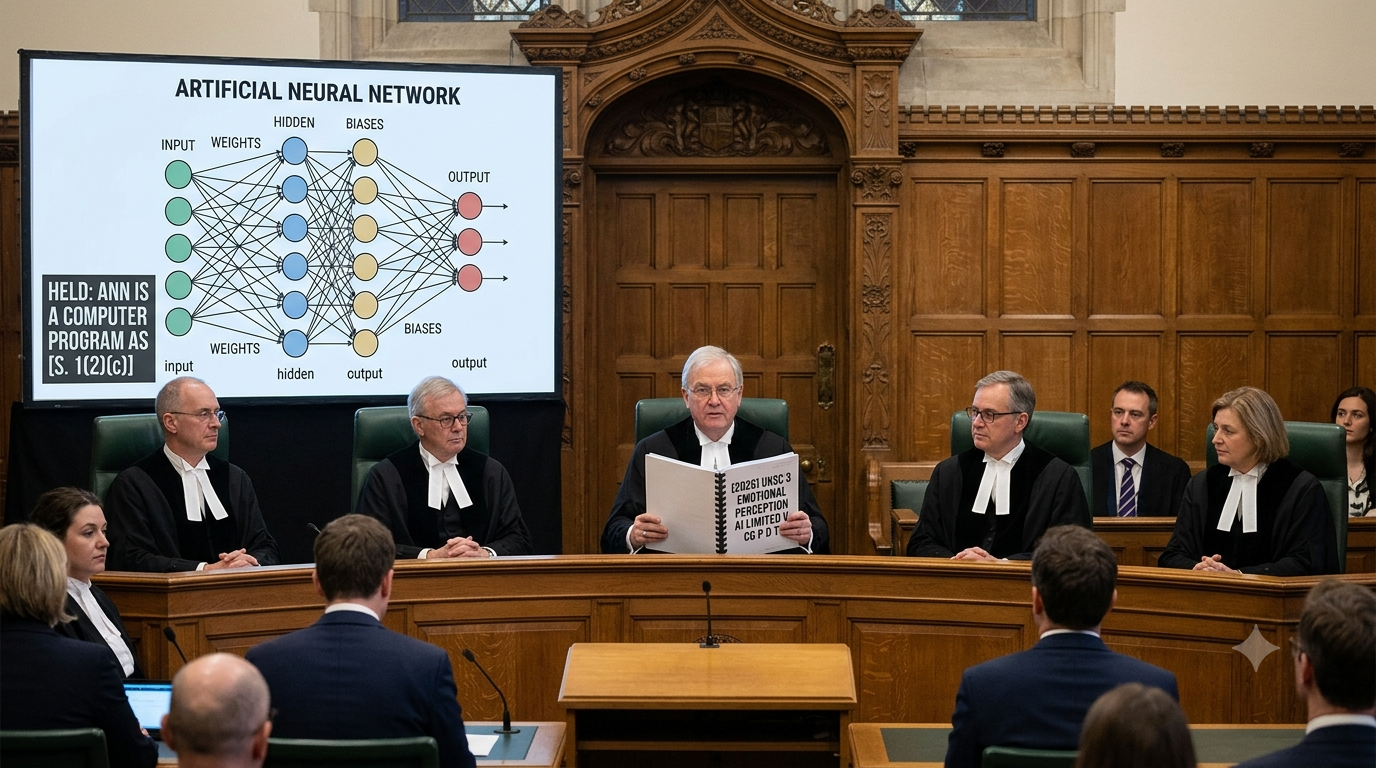
The Verdict on AI: Artificial Neural Networks are "Computer Programs"
One of the most critical aspects of the Emotional Perception judgment is how the Supreme Court defined Artificial Neural Networks (ANNs).
The Court rejected the idea that an ANN is purely a physical machine. Instead, it ruled that an ANN is an abstract model—a set of computational weights, biases, and topologies designed to manipulate data. Because of this, the Supreme Court declared that an ANN is legally a "program for a computer" under Section 1(2)(c) of the Patents Act 1977.
Crucially, the Court clarified that this classification applies universally, regardless of the underlying architecture:
- It applies whether the ANN is implemented on a standard digital computer, a quantum computer, or hard-wired directly into silicon (like FPGAs or custom AI chips).
- It applies whether the software instructions were written by a human engineer or generated autonomously via machine learning algorithms.
The Silver Lining for AI Builders
While being labeled a "computer program" sounds restrictive, the "any hardware" entry test means your AI system will easily pass the initial eligibility phase (Hurdle 1). The success of your patent application will now hinge entirely on the Intermediate Step—proving that your network’s specific data manipulations solve a concrete technical problem rather than an abstract or purely commercial one.
What This Means for Your IP Strategy
If you have pending applications or have previously faced exclusions under the old Aerotel rules, the UKIPO has instructed its examiners to reconsider responses under this fresh lens.
Moving forward, drafting patent claims requires a laser focus on the technical environment. Simply detailing an innovative machine learning model is no longer enough; your application must clearly articulate how that model optimizes hardware performance, processes physical signals, controls an industrial process, or addresses underlying system vulnerabilities.
To review the original oral arguments and visual context of how the UK judiciary approached this issue, you can watch the Supreme Court Case Broadcast, which records the detailed legal debates concerning the definition of computers and machine learning infrastructure under section 1(2)(c).