PCT National Phase Cost Comparison: India vs EPO vs USPTO vs Japan (2026)
Mid-sized Indian applicants searching for the real cost of moving a PCT international application into national phase across India and the three biggest receiving offices will get a thin financial answer from most IP blogs. The honest reason is that WIPO's PCT fees, each designated office's national-phase entry fees, and translation costs all change on different cycles, with different effective dates. A blog quote from January is structurally different from a blog quote from July.
This guide walks through the four cost components that apply to every PCT national-phase entry, frames how those components differ across India, the European Patent Office (EPO), the United States Patent and Trademark Office (USPTO), and the Japan Patent Office (JPO), and gives a defensible 2026 budget for the applicant who wants to enter priority markets. The realistic all-in cost for a single PCT application entering three of these four jurisdictions sits in the high five figures to low six figures of INR, with translation costs being the largest delta between jurisdictions.
Why PCT National Phase Costs What It Costs
PCT national phase is the second half of the international PCT journey. The applicant has filed an international application under the Patent Cooperation Treaty, designating the jurisdictions where they want patent protection. The international phase covers search and, optionally, a preliminary examination. The national phase entry is what transitions the application from international phase into each individual regional or national patent office, where it is examined under that office's substantive patent law.
The national-phase entry fees are not driven by symmetry across offices. Each office sets its own fees in its own currency, with its own per-page translation, and its own attorney-association rules. The applicant cannot avoid these differences — entering India costs a different combination of government fees and professional services than entering EPO, USPTO or JPO, and the gap is concentrated in translation.
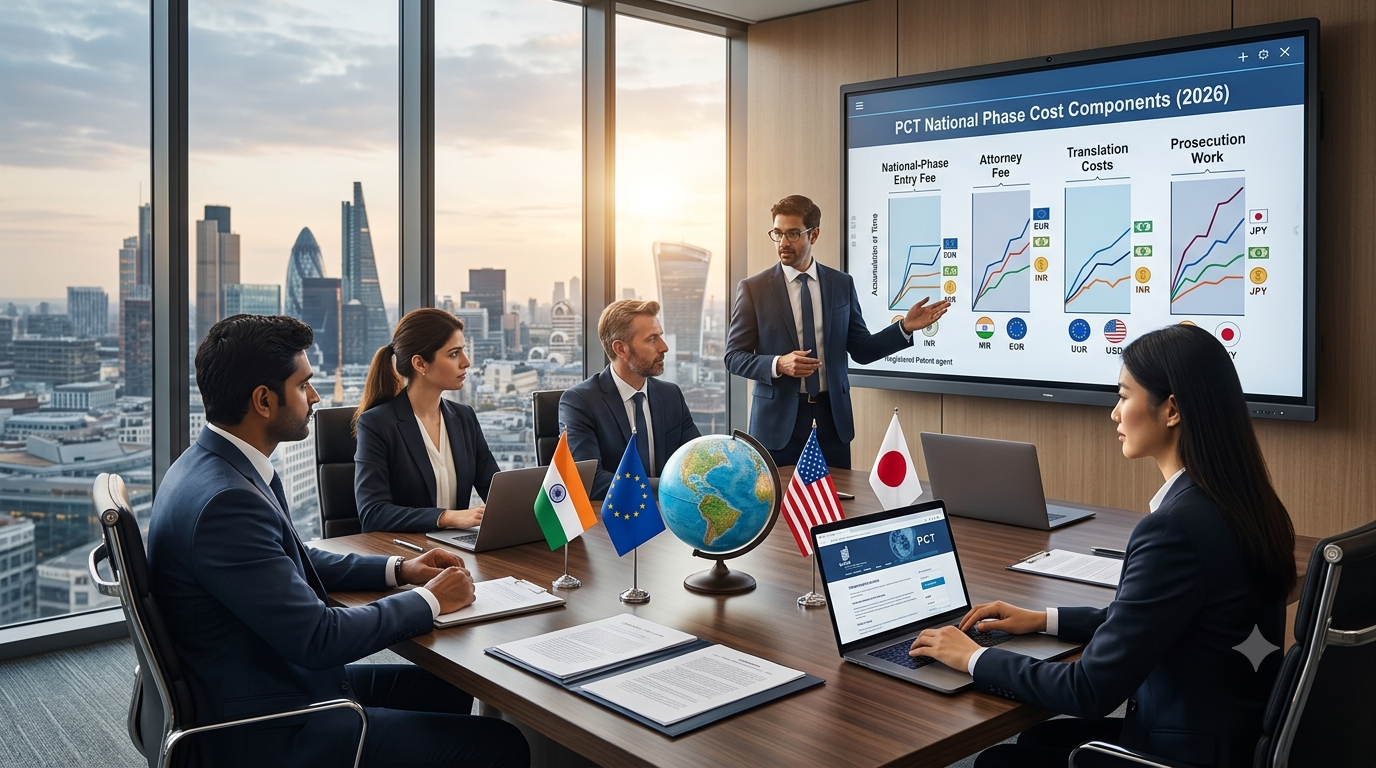
The cost stack for every PCT national-phase entry has four components: the prescribed national-phase fee under the national PCT implementing law, the attorney or registered-agent fee for filing and prosecution at that office, translation costs for the published application, and per-page or per-claim fees where the office charges them. Translation is the largest variable and the one most applicants underestimate when they first plan a multi-jurisdictional PCT pipeline.
The Four Cost Components of Every PCT National Phase Entry
The PCT national phase cost has four components that apply across every office. The applicant should price each separately for every jurisdiction the application enters.
The first component is the prescribed national-phase fee. Each national office sets this in its own currency. The fee typically covers the formalities of moving the international application into national processing, including entry fees, claim fees where the office charges per claim, and search-fee forwarding where the office relies on a separate later search.
The second component is the attorney or registered-agent fee. Filing actions and substantive prosecution at the office are professional work. The fees vary based on the technical complexity of the application and the prosecution track record of the office.
The third component is translation. JPO and EPO accept English in many proceedings but require an officially translated version for the state of the file. USPTO accepts English filings directly. India accepts English filings directly. This English-language acceptance has one important caveat: if the original PCT application was filed in a non-English language, such as German, Chinese, French, Japanese or Korean, the applicant must still supply a full English translation of the application as published, even for entry into the USPTO and India. Translation is therefore a meaningful cost in EPO and JPO entries, a modest cost in USPTO and India entries where the PCT publication is already in English, and a significant cost in USPTO and India entries where the PCT publication is in another language.
The fourth component is prosecution work after entry. The substantive examination at the office is a separate and often ongoing cost that runs through grant. Some patent prosecutions are settled without office actions. Others involve multiple rounds of office-action response, particularly where the office has a specific substantive bar (e.g. EPO's Article 56 inventive-step framework, JPO's distinctiveness-over-prior-art test, USPTO's subject-matter eligibility for software and AI inventions).
Crossing the Four Offices: What Settles Into the Same Pattern
The four offices share three structural facts. The applicant needs to enter and pay entry fees in the local currency under local PCT implementing law. The applicant must engage a registered representative at that office for substantive prosecution. The applicant incurs translation cost where the published international application has to be supplied in a non-English working language.
What differs across the offices is the size of the entry-fee stack, the language rules, and the active prosecution pathway.
India accepts the PCT international application directly into the national-phase basket as an English filing under the Patents Act, 1970 (as amended). Translation is not typically required for the application itself where it is published in English, but the patent specification and claims filed become the basis of the substantive examination.
The European Patent Office proceeds under the European Patent Convention, validated post-grant into individual EPC member states. Translation is required post-grant for the validation step into the relevant member-state languages, and there is an additional per-claim fee for claims above a small threshold.
The United States Patent Office accepts the priority under 35 U.S.C. § 365 with English-language filing. Translation is minimal in the US entry where the PCT publication is in English, but the application is reviewed under closely tuned subject-matter eligibility rules for software and AI inventions, which produces additional prosecution cost where the application is in those technology areas.
The Japan Patent Office accepts the application under Japan's PCT implementing law. Translation is required into Japanese for prosecution documents or for grant-related filings.
Realistic 2026 Cost Scenarios for Three-Jurisdiction National-Phase Entries
Three realistic scenarios for a mid-sized applicant entering a single PCT application into three of these four offices.
In Scenario A, an applicant files PCT and designates India, EPO and the US. The priority jurisdiction matters for translation. The applicant pays entry fees at India, EPO and USPTO in their respective currencies, engages Indian patent counsel for India entry, EPO counsel for European regional phase, and US patent counsel for US entry. Translation burden is meaningful in the EPO step. The all-in cost runs in the high five figures to low six figures of INR.
In Scenario B, an applicant files PCT and designates India, EPO and Japan. The Japan designation adds Japanese-language translation work. Translation burden is meaningful in both EPO and JPO steps. The all-in cost shifts upward because translation now runs in two languages.
In Scenario C, an applicant designates all four offices. The translation burden in EPO and JPO dominates the total. The all-in cost runs in the mid six figures of INR through national-phase entry alone, before substantive prosecution costs.
Hidden Costs That Catch PCT Applicants Off Guard
Five line items that break a multi-jurisdictional PCT national-phase budget.
The first is the European Patent Convention validation post-grant. Validation into individual EPO member states is a separate cost after grant and runs in member-state currencies with translation. Validation is the cost most PCT applicants forget when they first price EPO entry.
The second is Japanese-language translation for the JPO's filing work post-grant. Japanese translation involves a different vendor pool and a different lead time than European translation.
The third is per-claim fees in EPO and USPTO where the application has a high claim count. PCT applicants often file with a generous claim set to defer the cost of claim narrowing. The national-phase fee scales with claim count for these offices.
The fourth is the national-phase entry deadline. The PCT does not impose a single uniform deadline across designated offices. India and the EPO permit national-phase entry up to 31 months from the priority date, but the USPTO and the JPO impose a strict 30-month deadline from the earliest priority date under 35 U.S.C. § 371 and Japan's PCT implementing law respectively. Missing the relevant deadline forfeits the application in that jurisdiction. The 30-month and 31-month calendars run without exception under most circumstances, and most applicants miss these deadlines only once.
The fifth is substantive-prosecution cost, which is usually the largest component of the all-in cost where the application is in a cutting-edge technology area.
Legal Ways to Bring the Multi-Jurisdictional PCT Cost Down
Five legitimate routes reduce a multi-jurisdictional PCT national-phase budget.
File at the receiving office that accepts the lowest-cost e-filing. WIPO's PCT international filing fees vary slightly by receiving office. The international search-fee cost varies more substantially.
Limit the designated states to those where the applicant genuinely has commercial path. The cost-per-designation scales, and a "designate everything now" approach is almost always more expensive than the "designate only what the roadmap justifies" approach.
Threat the application for inventiveness and patentability before PCT filing. Pre-investment in a clean international search opinion reduces national-phase prosecution cost where the office's substantive test is rigorous.
Use the PCT international preliminary examination productively where the receiving office allows it. The international preliminary examination builds record on patentability that national-phase examiners tend to weigh, especially in EPO and JPO.
Threat translation burden early. Pooling translations across related applications through a single vendor often produces per-page savings.
Frequently Asked Questions About PCT National Phase in 2026
What Is National Phase in PCT?
National phase is the second half of the PCT journey. After an international application has been filed under the Patent Cooperation Treaty and the international search has been issued, the applicant enters national phase at each designated regional or national patent office, where substantive examination proceeds under that office's patent law.
When Is The National-Phase Deadline?
The deadline depends on the designated office. India and the EPO permit national-phase entry up to 31 months from the priority date under PCT Article 22 and the regional phase provisions of Article 39 respectively. The USPTO and JPO impose a strict 30-month deadline from the earliest priority date under 35 U.S.C. § 371 and Japan's PCT implementing law respectively. Restoration of rights is not universally available, and most applicants miss these deadlines only once.
What Does A PCT Applicant Save By Entering Late?
Entering late concentrates the attorney-association and translation cost into the back end of the application. The investment earlier is in the international phase and in better priority positioning. PCT is not an economic strategy for late entry; it is a coordination strategy for early entry with late national investment.
Is The Cost Of PCT Entry Recoverable From PCT Filing Fees?
No. The PCT international filing fee at WIPO is a small fraction of the total PCT national-phase cost across the designated offices. International filing cost coverage rises substantially through the four cost components above.
What Costs Are Recoverable Through PCT National-Phase Fees?
The national-phase entry fees are set by the designated office and are a separate billing from the international phase. They are not refundable. The applicant looking at cost recovery in a hypothetical grant needs to evaluate the full cost of translation and prosecution, not just the entry fee alone.
If Priority Is Lost Between Offices, Does The PCT Application Still Travel Through National Phase?
No. If the priority claim is invalidated, the national-phase application falls back to the international filing date and loses the priority-based position. The applicant cannot rely on a lost priority claim through the PCT.
How Does PCT Work With The Indian Startup Rebate?
The Indian Patent Office's 80 percent rebate applies to the Indian national-phase entry fee where the applicant qualifies as a natural person, startup or small entity under the Patents Act, 1970 (as amended) and the Patents Rules. The international phase fee at WIPO is not subject to the Indian rebate. The applicant should account for the rebate eligibility when pricing the Indian element of a multi-jurisdictional PCT strategy.
How Long Does National-Phase Examination Take Across The Four Offices?
Grant timelines vary. India runs four to six years for mechanical and pharma patents and shorter for well-drafted AI and software patents. EPO runs three to five years. USPTO runs two-and-a-half to four years for typical technologies. JPO examination timelines generally run similarly to the EPO, around 1 to 3 years after the applicant files a request for substantive examination.
What About Provisional Patent In India?
Provisional patents establish priority date in India without a complete specification. The applicant has twelve months to file the complete specification. PCT national-phase entry can proceed out of the complete specification regardless of whether the first Indian filing was provisional.
Key Terms Explained
The PCT cooperation treaty is an international patent filing treaty administered by WIPO. A single international application designates member states. The procedure is governed by the PCT Regulations. As of the latest WIPO Member States list, the PCT has more than 150 contracting states.
The international phase is the early stage of the PCT procedure. It includes international filing, international search, and optional international preliminary examination. National-phase entry does not start until the international phase is complete.
National phase is the stage where the international application enters each designated jurisdiction for substantive examination under that jurisdiction's domestic patent law.
Receiving office is the national or regional office where the international application is filed. WIPO is one receiving office among many. Choices among receiving offices affect international filing-fee costs through receiving-office specific fees.
The national-phase deadline from the priority date varies by designated office. India and the EPO permit entry up to 31 months from the priority date. The USPTO and JPO impose a strict 30-month deadline from the earliest priority date.
The European Patent Office (EPO) is the regional patent office acting under the European Patent Convention. Validation post-grant extends the granted patent into member states.
The United States Patent and Trademark Office (USPTO) is the national patent office of the United States. The US pursues patent prosecution under 35 U.S.C. Patent Act authority.
The Japan Patent Office (JPO) is the national patent office of Japan. Japanese-language translation is required for prosecution work and grant-related filings.
India national phase entry under the Patents Act, 1970 (as amended). Entry on prescribed form and prescribed fees. The Indian Patent Office rebate applies to prescribed forms when eligibility is established.
Translation is the cost of rendering the international application into a working language of a designated office where required. Japan and EPO post-grant validation are typical highest-cost translation tiers. USPTO and India accept English-language filing where the PCT application is published in English, but where the PCT publication is in another language, a full English translation is still required for national-phase entry.
WIPO is the World Intellectual Property Organisation. Administers PCT, Madrid, Hague and other international IP filing systems.
The PCT international filing fee is paid to WIPO and the receiving office. Cost basis: WIPO Schedule of Fees Annex. PCT fee schedule is updated by WIPO at intervals and the applicant should verify current figures.
National-phase entry fee is paid to the designated office. Cost basis: each office's respective national PCT implementing schedule.
The international search-fee is paid to the international searching authority. Cost basis: each ISA's fee schedule.
Filed under Patent PCT. See also How Indian startups can file a US patent — the cost path from provisional to grant. See also Filing under the Geneva Act of Lisbon: Indian apps and designs going global.