Bisleri v. Kalabyraveshwara Mineral Water: Bombay HC Confirms Ex Parte Order and Disposes of Receiver's Report (2026)
Bisleri v. Kalabyraveshwara Mineral Water: Bombay HC Confirms Ex Parte Order and Disposes of Receiver's Report (2026)
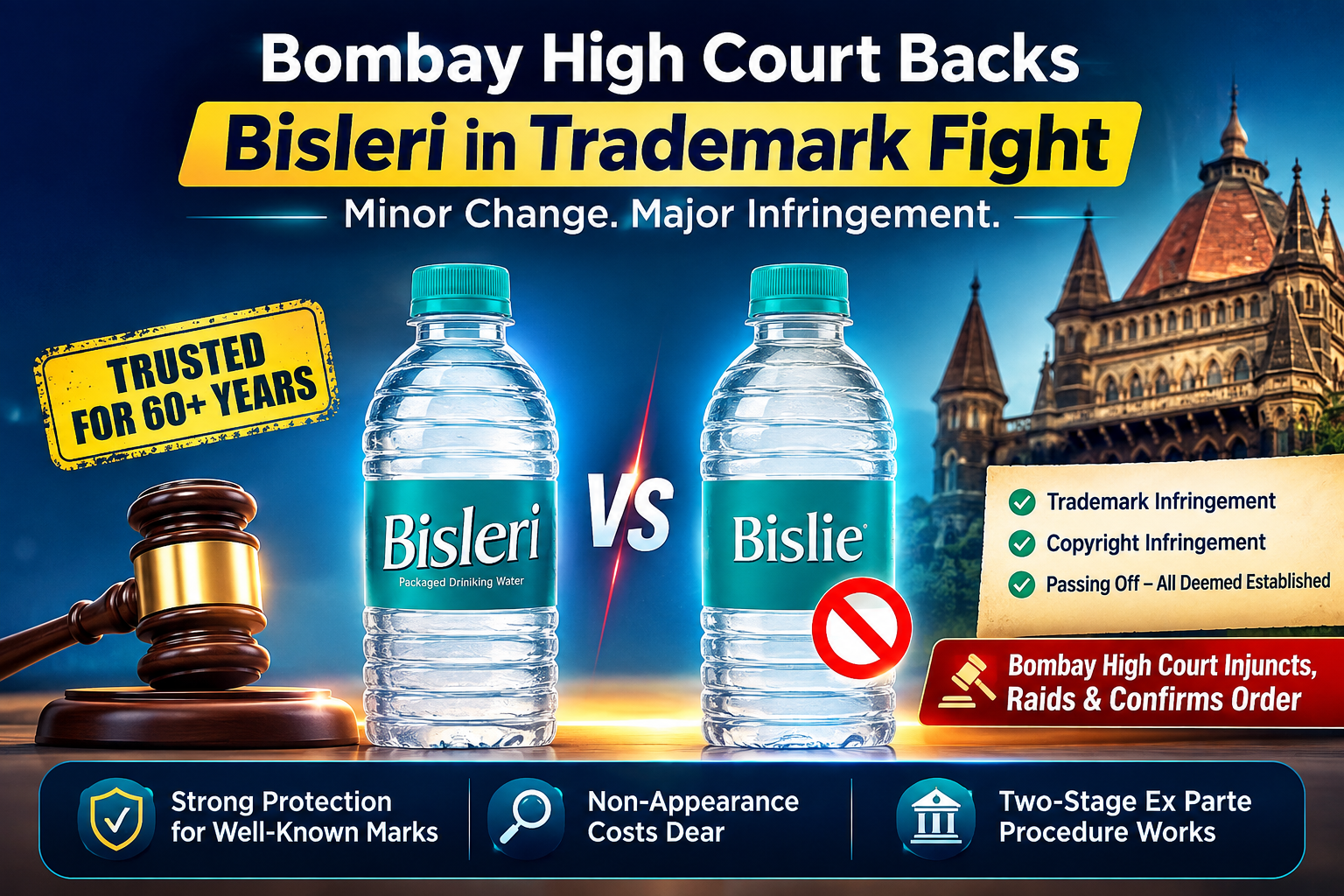
A six-letter, six-decade-old trademark got shaved by one letter and shuffled by two and Justice Madhav J. Jamdar of the Bombay High Court ordered a Karnataka factory searched, its finished goods seized, and its production equipment taken into custody. The complete sequence of orders begins on 11 June 2026, when the Bombay High Court granted the initial ex parte ad-interim order and appointed a Court Receiver; the search-and-seizure raid was executed at the defendant's premises shortly thereafter; and the order dated 7 August 2026 formally confirmed the injunction and disposed of Receiver's Report No. 292 of 2026. That sequence is the holding of the recent order in Commercial IP Suit (L.) No. 18582 of 2026, in which Bisleri International Private Limited obtained ex parte ad-interim relief against Belaguli Mahalingegowda Kirankumar, proprietor of Kalabyraveshwara Mineral Water Industry, over the mark "Bislie".
This is not a complicated case on the facts. The defendant deleted the letter "r" from "Bisleri" and swapped the position of "e" and "i". He also lifted the colour scheme, the layout, the get-up, and the artistic work on Bisleri's labels artistic works that Bisleri protects under copyright registrations held with the Copyright Office. The defendant was served but did not appear at the returnable hearing. Justice Jamdar found a strong prima facie case for trademark infringement under Section 29(2) read with Section 29(4) of the Trade Marks Act, 1999, primary copyright infringement under Section 51 of the Copyright Act, 1957, and passing-off and confirmed the ex parte ad-interim order originally granted in June.
For Indian brand owners, startup founders, MSME trademark registrants, and IP litigators, this order is a textbook illustration of three concurrent lessons: how weak a "minor textual variation" defence is when the disputed mark is a well-known mark, how damaging non-appearance is in a contested commercial IP suit, and how the Bombay High Court's two-stage ex parte procedure initial relief in June, Receiver's raid mid-year, confirmation plus Receiver's Report disposition in August actually works in Indian trademark litigation.
Bisleri as a Well-Known Mark in India
Bisleri International Private Limited has, through decades of continuous and extensive use since the 1960s, accumulated the kind of public recognition in India that brings a mark under the elevated protection available to well-known trademarks. The mark "Bisleri" is applied to bottled drinking water and allied beverages, and is one of those rare cases where a brand name has slipped into popular usage "Bisleri" is now commonly used across much of India as a generic synonym for bottled water itself.
In Indian law, well-known mark status is determined under Section 2(1)(zg) of the Trade Marks Act, 1999, read with Rule 124 of the Trade Marks Rules, 2017, which empowers the Trade Marks Registry to maintain recognition of marks recognised as well-known. Once a mark enters that recognition tier, it enjoys both:
- Heightened refusal-of-registration protection at the Registrar under Section 11 of the Trade Marks Act on relative grounds regarding conflict with earlier marks, including well-known marks.
- An enlarged scope of infringement analysis under Section 29(4) the statutory anti-dilution route that protects the distinctive character and repute of a well-known mark against uses even on dissimilar goods that take unfair advantage of, or are detrimental to, that distinctiveness.
Bisleri's mark sits firmly inside that framework, and the defendant's product fell squarely within it.
The Lodging, the Suit, and the Procedural Timeline
The suit was instituted on the Original Side of the Bombay High Court, where the case number carries the suffix "(L.)" "Lodging", a provisional tracking number assigned by the Bombay High Court Registry upon filing. The Lodging prefix is purely administrative; it indicates the Registry's intake point and is later substituted by the court with a permanent regular suit number once pleadings are complete. Commercial IP Suit (L.) No. 18582 of 2026 is therefore simply the commercial-IP suit the defendant was served with not a transfer, leave petition, or appellate initiation.
The procedural timeline of this case unfolded in three distinct stages:
- 11 June 2026: Justice Madhav J. Jamdar heard Bisleri's interlocutory application on an urgent basis, granted the ex parte ad-interim injunction, and appointed the Court Receiver with directions to enter the defendant's premises at the factory location. The interim injunction was operative from this date forward.
- Between 11 June and 7 August 2026: The Court Receiver, accompanied by plaintiff representatives, counsel, and a videographer, executed the search-and-seizure raid at the Kalabyraveshwara Mineral Water Industry premises in Karnataka. The Receiver seized all infringing finished goods ("Bislie"-marked mineral water bottles), packaging materials (blank and printed labels, caps, wrappers, shrink sleeves, outer cartons), and production equipment (filling, capping, blow-moulding, and labelling machinery). The Receiver then filed Receiver's Report No. 292 of 2026, documenting the seizure and inventorying the goods and equipment taken into custody.
- 7 August 2026: Justice Madhav J. Jamdar heard the matter on the returnable date, confirmed the ex parte ad-interim order, formally disposed of Receiver's Report No. 292 of 2026, and continued the injunction pending further hearing.
For practitioners, this is the standard Bombay High Court Original Side sequence in commercial IP matters: Lodging number on filing, urgent ex parte hearing within days, Receiver's raid mid-stage, and confirmation plus Receiver's Report disposition at the returnable date.
The Accused Mark: "Bislie"
The defendant was running a mineral water manufacturing operation in Karnataka under the name Kalabyraveshwara Mineral Water Industry. The product carried the mark "Bislie" three of six letters identical to "Bisleri", one letter deleted ("r"), two letters rearranged ("e" and "i" swapped).
The variation was so mechanical that the court called it out for what it was. "Bislie" is not a derivative mark it is "Bisleri" edited by hand. The consonant skeleton "BSL" is preserved, the visual silhouette is preserved, and the phonetic pattern remains close enough that a shopfront consumer would not register the difference. Once you delete the only consonant in "Bisleri" that distinguishes it from neighbouring meaningless syllables, you have not created a new mark you have created a near-miss of the original.
Bisleri's Four-Layered Case Before the Bombay High Court
Bisleri's pleading was structured to layer four distinct causes of action against the defendant:
- Trademark Infringement under Section 29(2) of the Trade Marks Act, 1999: Use of a mark deceptively similar to the registered mark "Bisleri" in respect of identical goods (mineral water in Class 32 of the Nice Classification).
- Trademark Infringement under Section 29(4) of the Trade Marks Act, 1999: The statutory anti-dilution provision for well-known marks. Section 29(4) protects well-known marks against uses that take unfair advantage of, or are detrimental to, the distinctive character or repute of the mark, and does not require that the defendant's goods be identical or similar a broader scope than Section 29(2), which Bisleri's well-known status unlocked.
- Copyright Infringement under Section 51 of the Copyright Act, 1957, read with Section 13(1)(a) and Section 14(a): "Bislie"'s label artwork was substantially lifted from Bisleri's registered artistic works, with the colour scheme, layout, design elements, and get-up all reproduced. Bisleri's copyright over the label was registered with the Copyright Office by application on Form XIV under the Copyright Rules, 2013.
- Passing-off at Common Law: Independent of registered rights, the long goodwill of Bisleri's mark supports a tort claim of misrepresentation, with no requirement of registration to succeed.
The pleading at the ex parte stage was supported by Bisleri's registration certificates for its trademark, copyright registration certificates for its label artwork, photographs comparing the side-by-side product labels, and documentation tracing the defendant's commercial use of "Bislie" to dates on which the infringement was fresh.
Why the Defendant's Non-Appearance Mattered
The defendant was served but did not appear before Justice Jamdar's court on the returnable date. Under Order VIII Rule 10 of the Code of Civil Procedure, 1908, a defendant's non-appearance in a contested commercial IP suit after service does not pause the case it permits the plaintiff to proceed against the defendant by setting the matter ex parte and continuing on the plaintiff's own evidence.
This created a procedural asymmetry that the Bombay High Court leveraged cleanly. Without any rebuttal from the defendant's side, the plaintiff's prima facie case became effectively the only case on record. An uncontested trademark suit on a registered and well-known mark with clear phonetic and visual overlap is a textbook scenario for ex parte ad-interim relief initially granted in June and confirmed in August after the Receiver's Report was on record and Justice Jamdar took exactly that step.
The Court's Reasoning: Phonetic, Visual, and Conceptual Overlap Converge
Justice Madhav J. Jamdar found a strong prima facie case for Bisleri on four overlapping grounds:
- Deceptive Similarity under Section 29(2): "Bislie" is deceptively similar to "Bisleri" because the defendant did nothing more than delete a letter and rearrange two, with both marks used on identical goods (mineral water in Class 32). The visual similarity is near-identical, the phonetic similarity is substantial, and the structural similarity is total identical length, capitalisation, and rhythm.
- Anti-Dilution Infringement under Section 29(4): Independent of whether the goods are identical or similar, Section 29(4) protects against use of a mark that is identical with or similar to the plaintiff's well-known mark where such use takes unfair advantage of, or is detrimental to, the distinctive character or repute of the well-known mark. "Bislie" a deliberate phonetic and visual near-miss is the type of conduct the anti-dilution route was designed to capture.
- Copyright Infringement under Section 51: The court held that the defendant had reproduced the artistic work on Bisleri's labels colour scheme, layout, design elements, and overall get-up all protected as artistic work under Section 13(1)(a) read with Section 14(a) of the Copyright Act, 1957. Bisleri's underlying copyright registration, filed on Form XIV under the Copyright Rules, 2013, was admitted as documentary proof of both subsistence and ownership.
- Passing-off: Independent of the registered mark and copyright, the long goodwill of Bisleri's name supported a passing-off claim under common-law principles.
Disposal of the Receiver's Report and Confirmation of the Injunction
When the matter returned on 7 August 2026, the Court faced two distinct tasks: (i) confirming the ex parte ad-interim order already in force since 11 June 2026, and (ii) formally disposing of Receiver's Report No. 292 of 2026, which documented the inventory of seized goods and equipment.
Justice Jamdar did both. The injunction was confirmed on merits across all grounds. The Receiver's Report was placed on record, the inventory of goods and equipment was confirmed, and the seized materials were directed to remain under the Court's custody pending final hearing.
This two-stage structure urgent relief in June, confirmation plus Receiver's Report disposition in August gives plaintiff counsel a clear path from ex parte application to confirmed relief without losing the Receiver's interim custody of seized stock and machinery along the way.
Strategic Takeaways for Indian Brand Owners
- Deceptive Similarity and Anti-Dilution are Tested Separately: Trademark law in India protects registered marks under Section 29(2) on the standard identical/similar goods route. But well-known marks unlock an additional Section 29(4) anti-dilution layer that protects the mark's distinctive character and repute even without identical-goods overlap. Layering both routes ensures maximum structural strength in court.
- Get-Up Copying Strengthens the Case: When a defendant copies the colour scheme, design layout, and artistic work of a registered mark's labels, the case moves from a boundary debate to clear evidence of deliberate infringement. Combining trademark registration (Form TM-A) and copyright registration (Form XIV) converts a trade-dress dispute into a clean statutory infringement suit.
- Ex Parte Interim Relief is Reachable: When evidence is properly organized, marks are registered, infringement is ongoing, and the defendant fails to appear, courts will grant ex parte ad-interim relief at the urgent stage and confirm it at the returnable date, backed by a Court Receiver raid.
- Non-Appearance carries Heavy Consequences: For defendants, non-appearance does not delay proceedings it allows the plaintiff to present an uncontested case directly to the court.
Frequently Asked Questions
What is a well-known trademark in India, and how is the status confirmed?
A well-known trademark in India is one recognised as well-known by the Trade Marks Registry under Section 2(1)(zg) of the Trade Marks Act, 1999 read with Rule 124 of the Trade Marks Rules, 2017. Marks gain recognition through evidence of extensive use, registered history, market share, advertising spend, and prior decisions. Well-known marks enjoy heightened protection at the Registrar under Section 11 and an enlarged scope of infringement analysis under Section 29(4) independent of standard Section 29(2) provisions.
What is the difference between Section 29(2) and Section 29(4) of the Trade Marks Act?
Section 29(2) is the standard trademark infringement route focusing on use of a mark deceptively similar to a registered mark in respect of identical or similar goods. Section 29(4) is the anti-dilution provision for well-known marks; it protects against marks that take unfair advantage of, or harm, the distinctive character or repute of the well-known mark, even where the defendant's goods are not identical or similar.
Can deleting one letter and rearranging two avoid trademark infringement?
Almost never when the underlying mark is registered or well-known. Infringement is determined by overall phonetic, visual, structural, and conceptual similarity rather than literal letter-by-letter edits. Minor alterations on short, distinct marks are routinely treated by courts as deliberate mimicry.
What does "(L.)" mean in a Bombay High Court case number like Commercial IP Suit (L.) No. 18582 of 2026?
The "(L.)" suffix stands for "Lodging" a provisional tracking number assigned by the Bombay High Court Registry upon initial filing on the Original Side. It is an administrative intake identifier used while pleadings are finalized, after which it is converted to a regular suit number.
How does the Bombay High Court's standard two-stage ex parte procedure work?
The first stage is the urgent ex parte hearing where the court evaluates the prima facie case, issues temporary injunctions, and may appoint a Court Receiver to conduct search and seizure. The second stage occurs on the returnable date, where the Court evaluates the Receiver's Report, considers any response from the defendant, and decides whether to confirm or recall the ex parte order.
Key Terms Explained
- Commercial IP Suit (L.) No. 18582 of 2026: A commercial intellectual-property suit filed on the Original Side of the Bombay High Court. The "(L.)" suffix denotes "Lodging", representing an administrative tracking number assigned upon filing.
- Section 2(1)(zg), Trade Marks Act, 1999: Defines "well-known trademark" by reference to public recognition in India, irrespective of whether the mark is registered.
- Section 29, Trade Marks Act, 1999: The infringement framework. Section 29(2) handles deceptive similarity for identical or similar goods, while Section 29(4) provides anti-dilution protection for well-known marks.
- Section 13(1)(a) & 14(a), Copyright Act, 1957: Provisions establishing and defining statutory copyright protection for "artistic works", including label designs, artwork, and visual packaging elements.
- Order 39 Rules 1 and 2 CPC: Statutory provisions governing temporary injunctions (including ex parte ad-interim orders) in Indian civil procedure.
- Court Receiver & Receiver's Report: An officer appointed under Order 40 read with Section 151 CPC to execute search, seizure, and inventory directions. The Receiver's Report documents the executed inventory and condition of seized property for court records.
- Class 32, Nice Classification: The international classification category covering mineral and aerated waters, non-alcoholic beverages, and fruit juices.
Disclaimer: This post is for informational and educational purposes only and does not constitute formal legal advice. Intellectual property enforcement and defense strategies depend on the specific facts, evidence, and procedural posture of each individual matter.