Step-by-Step Guide to Madrid Protocol Trademark Filing for Indian Brands
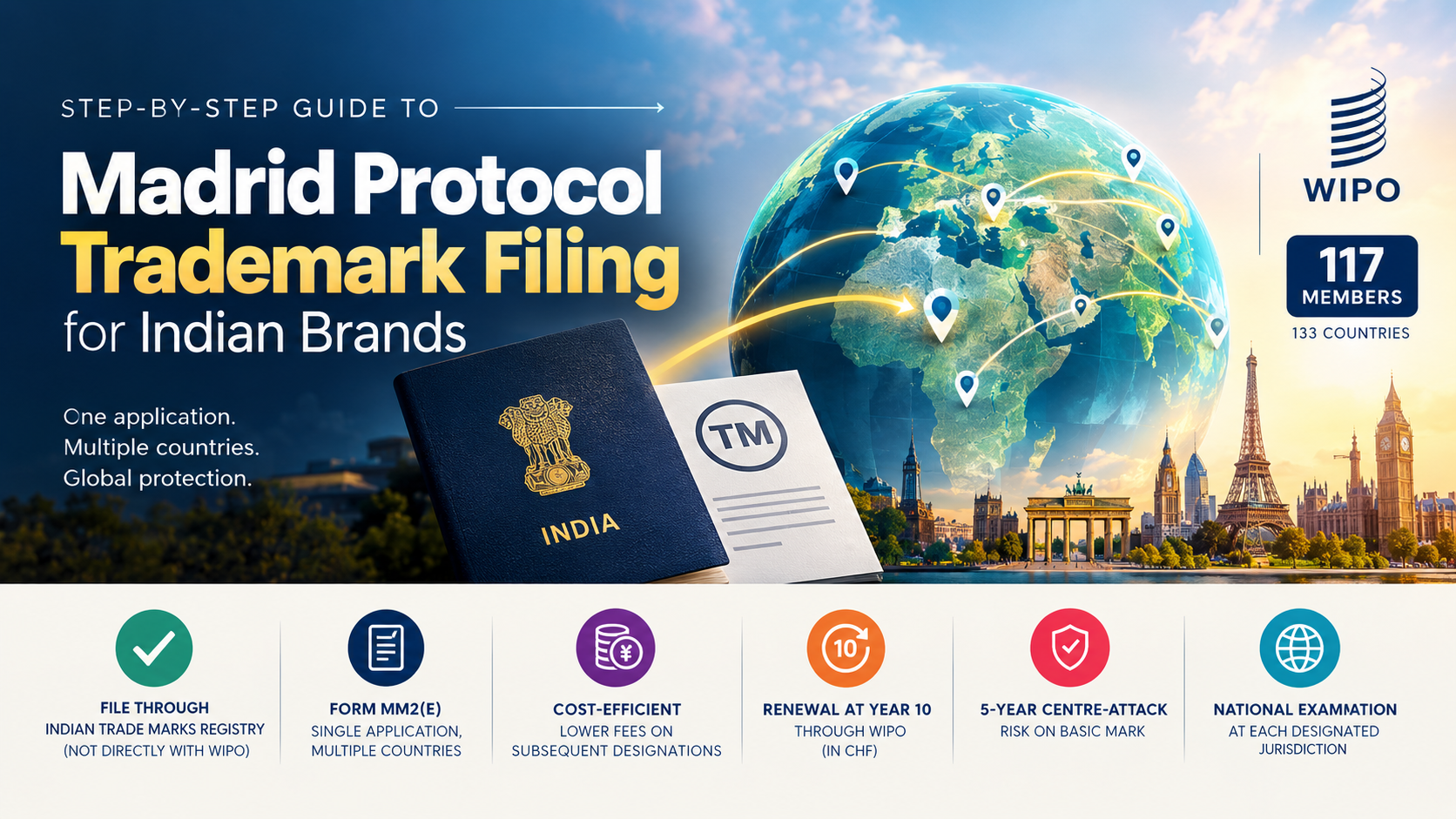
Step-by-Step Guide to Madrid Protocol Trademark Filing for Indian Brands
India acceded to the Madrid Protocol on 8 July 2013. For an Indian brand owner wanting trademark protection in multiple foreign jurisdictions, the Madrid Protocol administered by WIPO is structurally the most cost-efficient international filing route available in 2026. A single international application can carry your trademark into the Madrid Union's full perimeter 117 members covering 133 countries (WIPO Madrid System Members page, status as of 8 July 2026), including regional IP offices such as the EUIPO (European Union Intellectual Property Office) and OAPI (Organisation Africaine de la Propriété Intellectuelle). It is the alternative to direct national filings in each target country, which is structurally heavier, slower, and more expensive at scale.
This guide walks what an Indian brand owner solo founder, MSME exporter, DPIIT-recognised startup actually experiences when filing a Madrid Protocol international application in 2026, including the prerequisite basic mark, Form MM2(E) filing flow, fees in CHF and INR, the 5-year centre-attack window, and the renewal mechanic at year ten.
What is the Madrid Protocol?
The Madrid Protocol is an international treaty administered by WIPO the World Intellectual Property Organization under which a trademark owner can file a single application that designates one or more Contracting Parties from the Madrid Union. India is a member. The Protocol works on the principle of a "basic mark" a national trademark filing or registration in the applicant's home jurisdiction which serves as the anchor for the international application.
Indian applicants cannot file directly with WIPO under the Madrid Protocol; they must file through the Indian Trade Marks Registry's International Registration Wing (IRW) located at Mumbai, which transmits the application to WIPO. This differentiates Madrid from the PCT route for patents, where the Indian IPO does accept direct-from-India PCT applications under the PCT (Patent Cooperation Treaty).
Why the Madrid Protocol is the Most Cost-Efficient International Filing Route for Indian Brands
Three structural facts:
- A single Form MM2(E) replaces multiple direct national filings. Where a brand needs coverage in 5 Contracting Parties, Madrid is one filing — direct national is five filings.
- Fee reduction on subsequent designations. After the initial Madrid registration, adding new Contracting Parties is filed as a subsequent designation on Form MM4, at a reduced designation fee per Contracting Party per class no separate fresh filing required per country.
- Centralised renewal through WIPO. The Madrid international registration renews once at the year-ten mark, in CHF, through the WIPO IB, versus separate renewal fees in each national jurisdiction.
Three structural limits:
- The Madrid Protocol routes through a basic mark in the home country, which is attackable for 5 years (the "centre-attack" rule). If the Indian basic mark is invalidated within 5 years of the international registration, the Madrid registration can collapse though conversion to direct national filings under Article 9 quinquies of the Protocol is the procedural escape route.
- Class-counted fees in CHF designating a mark in Class 25 + Class 35 in 5 Contracting Parties costs more than designating only Class 25 in 5.
- National-office substantive examination happens at each designated jurisdiction. WIPO certification alone does not grant protection each national office examines on its own grounds.
Madrid Protocol Filing Procedure Step by Step
Step 1 — Have a basic mark in India. Either an existing Indian TM-A application (filed under Section 18 of the Trade Marks Act, 1999 read with Rule 21 of the Trade Marks Rules, 2017) or an existing Indian registration of the same mark. The Indian basic mark must be in the same name, with the same representation, and in the same Nice classification classes as the international application will carry. Goods and services description in the Form MM2(E) may be NARROWER than the Indian basic mark but CANNOT be BROADER. A common Indian Madrid filing error is trying to extend the international application to additional goods/services classes beyond what the Indian basic mark covers that is not permitted. Wording the international application to mirror exactly the Indian basic mark's class and goods description, or to narrow it deliberately, is the safe drafting rule.
A note on Nice Classification editions: every Madrid international application must comply with the current Nice Classification edition in force the 13th Edition at filing date 2026. If the Indian basic mark was filed or registered under an earlier edition of the Nice Classification, the goods or services description must be re-mapped to the 13th Edition classes when drafting the Form MM2(E) silently relying on the older edition numbers will be rejected by the WIPO IB at the formalities stage. The re-mapping exercise itself is a separate drafting block (no increase in fees, but a non-trivial legal-translation effort where the older edition used class headings materially different from current edition headings).
A practical warning on pending vs. registered basic marks:
- Filing a Madrid application based on a registered Indian mark is the structurally safest option the Centre Attack window is far narrower because the Indian registration is presumed valid, and any opposition or cancellation effort faces Section 47 / Section 57 of the Trade Marks Act, 1999 procedural thresholds (often including acquired distinctiveness and use-in-commerce evidence requirements at the Indian Trade Marks Registry).
- Filing a Madrid application based on a pending Indian TM-A application carries materially higher risk. Any refusal at the Indian examination stage (Section 9 absolute grounds, Section 11 relative grounds) automatically collapses the Madrid international registration globally during the 5-year centre-attack window. Any opposition at the Indian publication stage (Section 21 of the Trade Marks Act, 1999 read with Rule 42 of the TM Rules, 2017) does the same.
- The practical implication: when in doubt, delay filing the Madrid application until the Indian TM-A has either registered or reached the examination-clearance stage with no outstanding objection accepting some delay in exchange for structural risk-reduction. For D2C and MSME founders, this is one of the most consequential timing decisions in international IP strategy.
Step 2 — Draft the Form MM2(E) international application. Form MM2(E) is the prescribed form for Madrid international applications filed through the Indian IRW. It captures: applicant identification (matching the Indian basic mark exactly), the mark itself (wordmark, device, or composite matching the Indian basic mark representation), goods/services description (using the current Nice Classification edition currently the 13th Edition narrower or exactly matching never broader), and designated Contracting Parties from the 117 members covering 133 countries of the Madrid Union.
Step 3 — Pay the Madrid fees through the Indian IRW. The fee structure has two components: (a) the WIPO fees denominated in Swiss Francs (CHF) payable to the WIPO IB comprising a basic fee (653 CHF for a black-and-white mark representation; 903 CHF if the mark is in color or color is claimed) plus a per-Contracting-Party complementary fee or designation fee per Nice class; and (b) the Indian IRW transmission fee paid in INR (currently ₹2,000 per international filing, payable in INR to the Office of Origin the Indian Trade Marks Registry not in CHF) collected by the Indian Trade Marks Registry for processing the application through to the WIPO IB. The WIPO CHF-denominated fees and the Indian IRW INR-denominated transmission fee are denominationally distinct; the Indian IRW INR component is collected by the Office of Origin alongside the international filing, not by WIPO. The WIPO Madrid fee calculator at wipo.int/madrid/en/fees is the authoritative prefiguring source.
Step 4 — IRW transmits to WIPO's International Bureau (IB). The Indian IRW transmits Form MM2(E) plus attachments to the WIPO IB at Geneva. The IB checks formalities, records the international registration, publishes it in the WIPO Gazette of International Marks, and issues a certificate of international registration.
Step 5 — National offices may issue provisional refusal within established deadlines. Under Article 5(2) of the Madrid Protocol, designated national offices must notify the WIPO IB of any provisional refusal within 12 months from the date the IB transmits the request for extension of protection to that office. A Contracting Party may declare an 18-month refusal declaration period under Article 5(2)(b) and several major jurisdictions do. The United States (USPTO) operates on the 18-month refusal declaration period: under §68(c) of the US Trademark Act read with Article 5(2) of the Protocol, the USPTO must notify the WIPO IB of any refusal entered in a §66(a) application within 18 months of the date the IB transmits the request for extension of protection to the USPTO. The 12-month default under Article 5(2)(a) and the 18-month declaration under Article 5(2)(b) are the two operative refusal windows; an additional procedural device allowing declaration of opposition possibility beyond 18 months exists in select Contracting Parties but is structurally procedural rather than substantive.
Step 6 — National-office examination in each designated Contracting Party. Each national office examines on its own grounds (absolute grounds, relative grounds, descriptive objections, prior similarity). If no refusal issues within the applicable deadline (12 or 18 months depending on the Contracting Party's declaration), the mark is granted protection in that jurisdiction automatically. If a refusal issues, the applicant responds through that national office's local procedure this is not a WIPO-internal proceeding, it is a multi-jurisdictional national proceeding.
Step 7 — Statement of Grant of Protection or subsequent refusal tracking. Each designated Contracting Party can file a Statement of Grant of Protection with the IB confirming that protection has been granted. Tracking Statements of Grant and refusals is the operational reality of Madrid filings.
Step 8 — Renewal at year ten. Madrid international registrations are renewed at the year-ten mark through the WIPO IB, denominated in CHF. The renewal covers all designated Contracting Parties unless the applicant explicitly drops specific designations.
The Centre-Attack Rule (Five-Year Window)
A Madrid international registration remains dependent on its basic mark for the first five years from the date of international registration. Within that period, if the basic mark is invalidated or cancelled in India (e.g., opposition under Section 21 of the Trade Marks Act, 1999 read with Rule 42 of the TM Rules, 2017 succeeds, or the Indian registration is cancelled under Section 47 / Section 57), the Madrid registration can collapse globally all designated Contracting Parties can in principle treat the international registration as having the same fate.
A practical warning on pending-vulnerability amplification: filing the Madrid application on a pending Indian TM-A (rather than on a registered Indian mark) means the centre-attack vulnerability applies to two domestic-stage events simultaneously: (i) any Section 9 absolute grounds refusal at Indian examination, AND (ii) any Section 11 relative grounds refusal at Indian examination, AND (iii) any Section 21 opposition at Indian publication. Each of the three can trigger a global collapse of the Madrid international registration there is no firewall that limits propagation of an Indian-stage failure to only the Contracting Parties where the prior-action context would have applied. The practical implication is identical to the Step 1 warning: delay filing the Madrid application until the Indian TM-A is either registered or has cleared examination with no outstanding objection.
The operational implication for any Indian brand owner with Madrid filings, registered or pending:
- Defend the Indian basic mark aggressively in the 5-year window treat opposition defence as load-bearing, particularly for pending applications where the centre-attack exposure is materially amplified.
- Maintain the basic mark's status actively pay any required Indian renewal fees (TM-R under Section 12 of the Trade Marks Act, 1999 read with Rule 25 of the TM Rules, 2017, every 10 years if registered, vs. application status fees if still in the pre-registration phase).
- Have a conversion strategy under Article 9 quinquies of the Madrid Protocol, an applicant whose Madrid registration is invalidated can convert each designated national registration into a direct national filing, preserving the original priority date in most Contracting Parties. Conversion has its own fee and procedural track, and is the procedural escape route from a centre-attack collapse.
Madrid Fees in 2026 (CHF and INR reference)
The WIPO Madrid fee calculator at wipo.int/madrid/en/fees is the authoritative source. Common cost components for an Indian brand owner:
- Basic fee (WIPO IB, CHF): 653 CHF for a black-and-white mark representation; 903 CHF if the mark is in color or color is claimed.
- Complementary fee / designation fee (CHF): per Contracting Party per Nice class designated.
- Transmission fee (Indian IRW, INR): ₹2,000 per Form MM2(E) international filing, paid in INR to the Office of Origin (Indian Trade Marks Registry), not in CHF.
- Currency surcharge: where designated Contracting Parties require.
- Subsequent designation fee (Form MM4) for adding new Contracting Parties post-registration (CHF).
- Renewal fee at year-ten, per Contracting Party per Nice class (CHF).
The cost advantage is structural. Filing a mark in five Contracting Parties directly would mean five national filings, five national fees, five national agents, five prosecution tracks, five renewal schedules. Madrid consolidates this into a single filing through the Indian IRW, with WIPO coordinating across jurisdictions.
Contents of the International Application (Form MM2(E))
The standard Form MM2(E) shipment includes:
- Applicant identification (name, address, nationality / country of incorporation) must match Indian basic mark applicant.
- Mark representation must match Indian basic mark.
- Goods/services description using the current Nice Classification edition currently the 13th Edition must match or be NARROWER than Indian basic mark; never broader.
- Baseline designations the Contracting Parties where the applicant seeks protection at the outset.
- Priority claim (if applicable) priority from Indian basic mark filing date, with priority filed in the same goods/services classes as the basic mark.
- Signature by authorised applicant.
What Cannot Be Filed Through the Madrid Protocol
The Madrid Protocol is a trademark-specific filing route it does NOT cover:
- Industrial designs. India is not a contracting state to the Hague Agreement (Geneva Act 1999) as filing date 2026, so Madrid-style international design registration is not available to Indian applicants. Direct national design filings + Paris Convention priority routes are the alternative.
- Patents. The PCT (Patent Cooperation Treaty), not Madrid, is the patent international filing route.
- Copyright. Copyright arises automatically under Berne / UCC and is not subject to Madrid-style international registration.
Indian applicants seeking multi-jurisdictional protections across IP types should plan separate routes Madrid for trademark, PCT for patent, Paris Convention priority claims for trade marks + patents, bilateral FTAs for GIs.