Syngenta v. Controller of Patents: How the Delhi High Court Reframed Section 3(d) for Agrochemical Polymorphs
Syngenta v. Controller of Patents: How the Delhi High Court Reframed Section 3(d) for Agrochemical Polymorphs
A crystal form can change how an agrochemical works in the real world. The Delhi High Court has said that matters.
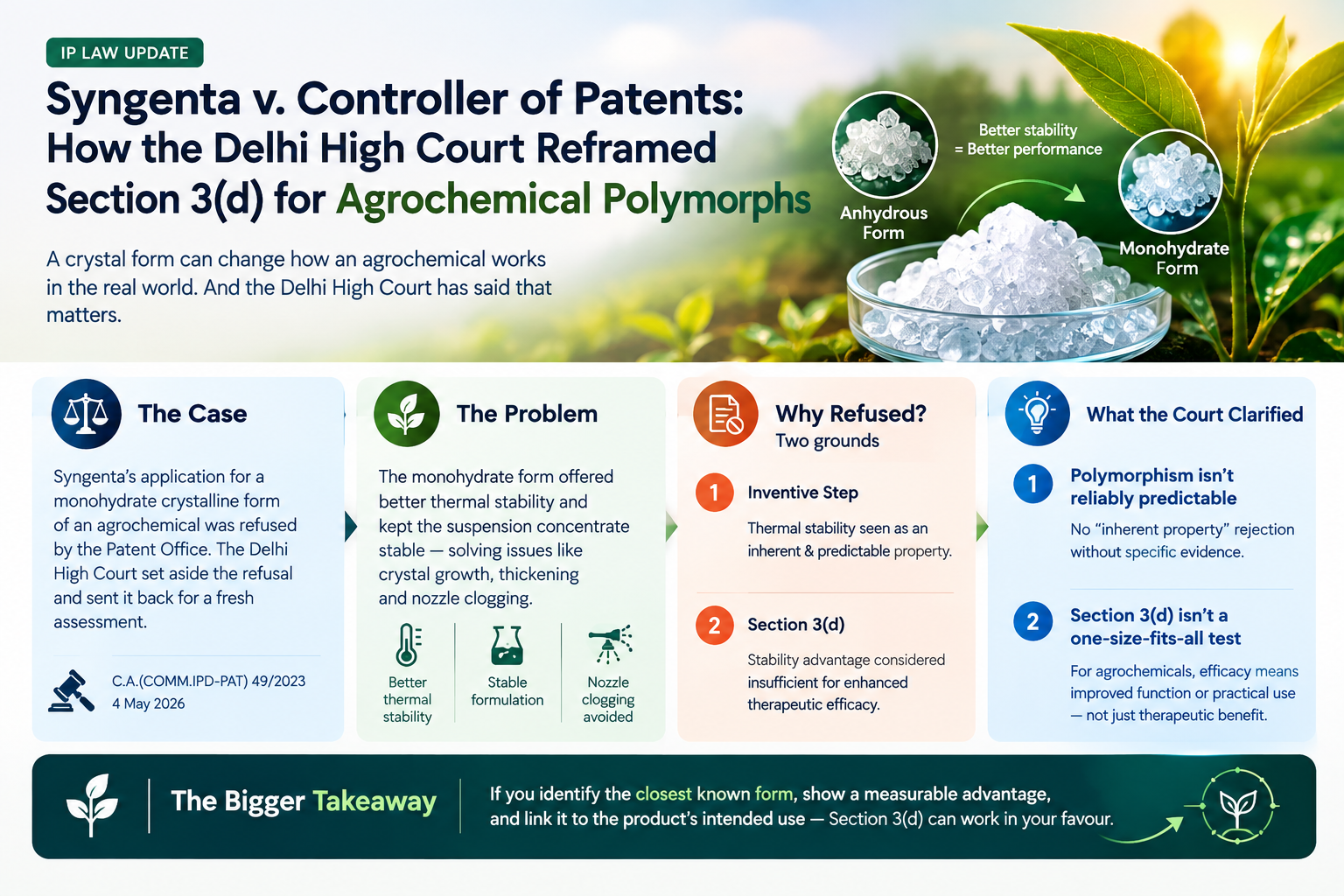
In Syngenta Participations AG v. Controller of Patents & Designs (C.A.(COMM.IPD-PAT) 49/2023, judgment dated 4 May 2026), the Court set aside the refusal of Syngenta's application for the amonohydrate crystalline form of an agrochemical compound and remanded the matter to the Patent Office for a fresh assessment.
The decision matters because it does more than reverse one refusal. It clarifies how the Patent Office should approach polymorph, hydrate, and formulation inventions more broadly particularly where Section 3(d) is invoked against applications outside the pharmaceutical space.
The Technical Problem Syngenta Set Out to Solve
The application concerned acrystalline monohydrate polymorph intended for use in agricultural formulations. Syngenta’s evidence focused on a concrete formulation and stability problem demonstrating improved thermal stability and addressing crystal growth that could affect the practical use of the formulation.
The known anhydrous form of the compound, when used in a suspension concentrate (SC), could undergo conversion to another crystalline form over time. This conversion was associated with crystal growth and deterioration of the formulation’s physical stability. For the end user, this could result in thickening during storage and difficulties during spraying, including potential nozzle clogging.
Syngenta supported the claimed monohydrate form with experimental data demonstrating improved thermal stability and greater stability of the suspension concentrate compared with the anhydrous form. The evidence therefore addressed a practical formulation and application problem arising from polymorphic conversion, rather than merely establishing that the claimed form was structurally different from the known form.
Why the Patent Office Refused the Application
Two primary grounds carried the refusal:
Inventive Step
Objection:
Thermal stability was treated as an inherent and predictable property of monohydrate polymorphs.
Syngenta’s Response:
Syngenta argued that polymorphic properties are not automatically predictable. Experimental data were relied upon to demonstrate the improved thermal stability of the claimed monohydrate.
Section 3(d)
Objection:
The claimed stability advantage was considered insufficient to demonstrate enhanced therapeutic efficacy.
Syngenta’s Response:
Syngenta emphasized that the claimed invention related to an agrochemical, not a pharmaceutical. Therefore, efficacy should be assessed in the context of the product’s intended function and use, including the practical benefit of improved stability during spraying.
Syngenta’s response on record challenged both grounds. On the inventive step, it argued that the properties of polymorphs are not automatically predictable and that the claimed advantage was supported by experimental evidence rather than mere assertion. On Section 3(d), it argued that, for an agrochemical, efficacy should be assessed in light of the product’s intended function and use, rather than being limited to the therapeutic-efficacy standard applicable to pharmaceutical products.
What the Court Clarified
The judgment turns on two fundamental propositions:
1. Polymorphism is not reliably predictable, and "inherent property" rejections require a specific basis.
The Court said that the Patent Office cannot simply assume that a property, such as thermal stability, is automatically present in a polymorphic form. If the Patent Office relies on common general knowledge to make such a finding, it should have supporting evidence. The Court also noted that different polymorphs of the same compound can have different properties.
2. Section 3(d) is not a one-size-fits-all test.
The Court clarified that the concept of “efficacy” under Section 3(d) depends on the type and purpose of the product. The therapeutic-efficacy approach used for medicines cannot simply be applied to an agrochemical. For an agrochemical, the relevant question is whether the claimed property improves the product’s function or practical use. In this case, improved stability that helped maintain the formulation and prevent problems during spraying could therefore be considered when assessing enhanced efficacy under Section 3(d).
The combined effect is that where an applicant identifies the closest known form, demonstrates a measurable advantage, and links that advantage to the product’s intended use, the Patent Office should not reject the application simply by asserting that the property is “inherent” without supporting evidence.
What the Ruling Does Not Do
The judgment is not a blanket approval for polymorph patents. Syngenta's application has not been automatically granted. The refusal order has been set aside, and the matter has been remanded to the Patent Office for fresh consideration.
The Patent Office retains its lawful jurisdiction to test inventive steps and Section 3(d) on the actual evidence on record, including whether the data Syngenta has filed meets the standard the Court has now articulated.
The takeaway for applicants is conditional, not absolute: the ruling strengthens the analytical framework a strong solid-form application must satisfy; it does not remove the burden of generating the right evidence.
Why This Matters for Innovators
For applicants working on polymorphs, hydrates, co-crystals, salts, and formulation-grade actives, particularly outside the pharmaceutical space, Syngenta offers three practical lessons:
1. Identify the closest known form and the technical problem it creates.
A strong application should clearly identify the problem addressed by the newform, for example, crystal growth, thickening, formulation instability, or agglomeration, rather than relying only on a general claim of "improved stability."
2. Generate comparative evidence linked to the intended use.
The technical advantage should be supported by comparative data against the closest known form, preferably under conditions relevant to the product's intended formulation and use.
3. Link the technical advantage to the product’s function for Section 3(d).
For an agrochemical, as in Syngenta, the relevant question is whether the claimed property improves the product’s intended function or practical use. The broader lesson is that the Section 3(d) analysis should be connected to the actual purpose of the product rather than automatically applying a pharmaceutical therapeutic-efficacy framework.
The IP Strategy Takeaway
For polymorph, hydrate, and formulation inventions, structural characterization is important, but it is only part of the patent story. Techniques such as X-ray diffraction (XRD), differential scanning calorimetry (DSC) and spectroscopy can establish the identity and properties of a claimed form. The stronger question is: what technical advantage does that form provide, and why does it matter?
A persuasive patent strategy therefore connects the claimed structure → measurable technical advantage → intended product use. This can be supported through closest-form prior-art analysis, comparative experiments, and careful prosecution strategy addressing the relevant patentability requirements, including Section 3(d) where applicable.
The key takeaway is that prior-art analysis, evidence generation, and patent drafting should work together from the outset. For solid-form inventions, showing not only what the new form is, but also what it does better and why that improvement matters, can make the patent position more robust.
How We Can Help
We support innovators with prior-art searches, patentability assessments, Section 3(d) strategy, claims support reviews, and evidence-led prosecution for complex chemical and formulation technologies.
If your innovation depends on a specific form, stability profile, or formulation advantage in agrochemicals, specialty chemicals, dyes, flavors, or formulation-grade actives, our team can help turn the technical story into a focused patent strategy. We work backwards from the closest known form, plan the comparative evidence around the real use environment, and frame Section 3(d) around the function your product actually performs.
Frequently Asked Questions on Polymorph Patents and Section 3(d)
1. Does Syngenta mean all polymorph patents in India are now allowable?
No. The ruling set aside the refusal and remanded for fresh consideration. Each polymorph application still has to clear the inventive step and Section 3(d) on its own evidence. What the ruling does is narrow the scope of generalized "inherent property" rejections and reset Section 3(d) for non-pharmaceutical products.
2. Why was Section 3(d) framed around therapeutic efficacy in the first place?
The enhanced therapeutic efficacy test was developed in the pharmaceutical context, most prominently through the Novartis line of decisions, where the question was whether a new form of a known drug produced a meaningfully better clinical outcome. Syngenta holds that this framework cannot be mechanically extended to non-therapeutic products where the relevant efficacy is functional, not clinical.
3. Is the monohydrate form Syngenta claimed automatically patentable in India now?
No. The application has been sent back to the Patent Office for fresh examination. The Patent Office will test whether the comparative data actually establishes a meaningful advantage and whether the inventive-step argument is supported by the closest prior art on record.
4. Does this ruling affect pharmaceutical polymorph patents?
The judgment is directly about an agrochemical, so its strongest application is to non-pharmaceutical solid forms. Pharmaceutical polymorph practice in India continues to be governed by the Novartis framework and the Section 3(d) enhanced therapeutic efficacy test. However, the proposition that "inherent property" rejections require a specific basis will inform pharmaceutical prosecution as well.
What kind of evidence should applicants file for a polymorph patent after Syngenta?
Applicants should consider building the evidence around three layers:
1. Characterization data
XRD, DSC, TGA and relevant spectroscopic data to establish and characterize the claimed polymorphic form.
2. Comparative data
Comparative experiments against the closest known form, demonstrating a measurable technical advantage under conditions relevant to the product's intended formulation or use.
3. A Section 3(d) argument
The Section 3(d) analysis should connect the claimed property to the product’s function, utility and purpose. For non-pharmaceutical products such as agrochemicals, the analysis should not simply import the therapeutic-efficacy framework applied to pharmaceutical products.
Can a process limitation rescue a Section 3(d) rejection for a polymorph?
The Syngenta judgment does not establish a new doctrine under which a process limitation can, by itself, overcome a Section 3(d) objection.
Section 3(d) remains focused on the claimed product and whether the new form demonstrates the required enhancement in properties with regard to efficacy. A process limitation may be relevant to other patentability issues, including inventive step, depending on the claim and evidence. However, merely adding a process limitation does not replace the need to establish the relevant product-based advantage for Section 3(d).
Legal & Technical References Explained
Section 3(d), Patents Act, 1970
Section 3(d) excludes from patentability the mere discovery of a new form of a known substance unless the new form results in an enhancement of the known efficacy of that substance. Its Explanation specifically covers forms such as polymorphs and provides that they are considered the same substance unless they differ significantly in properties with regard to efficacy.
C.A. (COMM.IPD-PAT)
A case classification used by the Delhi High Court for patent appeals before its Intellectual Property Division. Such proceedings may include appeals under Section 117A against orders of the Controller of Patents, including decisions refusing or granting patent applications.
Polymorphism
The ability of the same chemical compound to exist in different crystalline forms. Different polymorphs can exhibit different physical and chemical properties, including differences in stability, solubility, and processing behavior.
Monohydrate
A crystalline form in which water molecules are incorporated into the crystal structure of the compound, typically in a defined stoichiometric ratio.
Suspension Concentrate (SC)
A liquid formulation in which solid particles of an active ingredient are dispersed in a liquid carrier. The physical stability of the suspended particles is important for maintaining formulation quality and effective application.
Polymorph Conversion
The transformation of one crystalline form of a compound into another under particular conditions, such as changes in temperature, humidity, or formulation environment. Such conversion can alter the physical properties and stability of the formulation.
Closest Prior Art / Closest Known Form
The relevant prior art form against which a claimed form is compared to identify differences, technicaleffects and the basis for assessing patentability.