AI Voice Cloning Hits the Trade Marks Registry: An India + Madrid Roadmap for Voice Marks
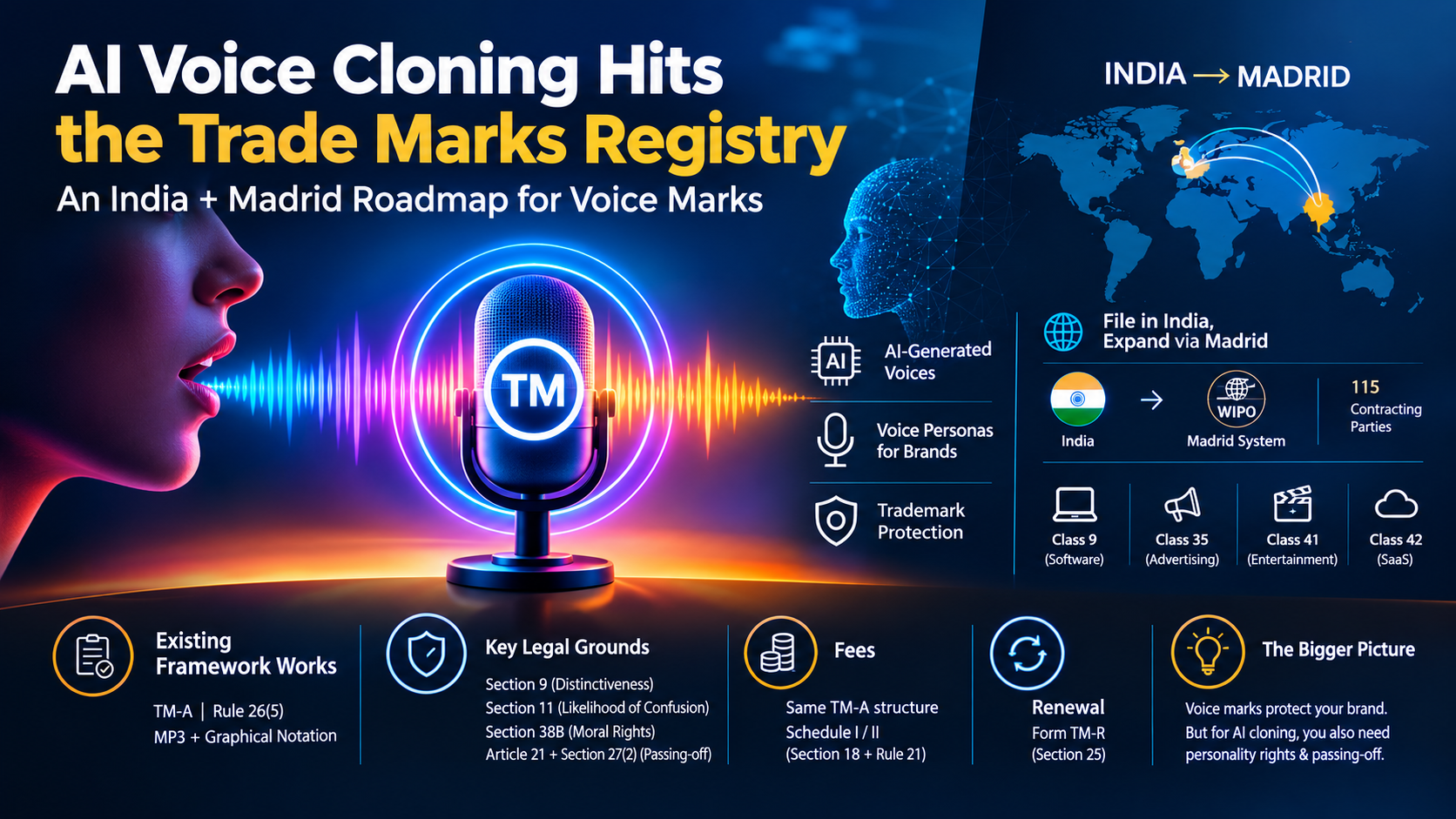
AI Voice Cloning Hits the Trade Marks Registry: An India + Madrid Roadmap for Voice Marks
The first wave of TM-A filings for AI-cloned and AI-synthesised voice marks is landing at the Indian Trade Marks Registry without a Trade Marks Rules amendment and without a regulator-issued specimen-of-use specification. The applicant relies on the existing Section 2(1)(zb) of the Trade Marks Act, 1999 definition of a "mark" together with sound-mark practice going back years. The procedural fault lines around Section 9 distinctiveness, Section 11 likelihood of confusion, and performer moral rights under Section 38B of the Copyright Act, 1957 are the real load-bearing vectors.
Why It Is Trending Now
The first commercially notable voice marks in India are AI personas rather than real human voices. Voice-cloning toolchains now let one brand deploy five or more synthetic voices for ads, IVR, audiobooks and metaverse environments and neither a slogan nor a hashtag protects a voice persona. A TM-A filing covering a tagline alone fails the moment a competitor re-records the same script in a near-identical synthetic voice. The move toward voice-mark registration is the brand owner's response.
The Existing Indian Framework Is Already Capable
The Trade Marks Act, 1999 does not exclude sound marks. Under Rule 26(5) of the Trade Marks Rules, 2017 the application cannot rely on an audio file alone it must include an MP3 audio file of the sound not exceeding 30 seconds, accompanied by a graphical representation of the sound notations, typically a musical-stave or notation transcription of the waveform. The fee tier is the same TM-A class-counted structure under Section 18 read with Rule 21 of the Trade Marks Rules, 2017 Schedule I (lower) for natural persons, DPIIT-recognised startups and small entities filing on their own behalf; Schedule II (higher) for all other applicants. No new statute, no new Rule, no new fee tier is required.
Where AI Voice Cloning Changes The Picture
The novelty lies at the copyright / personality intersection, not in the trademark procedure. Section 38B of the Copyright Act, 1957 protects the moral rights of the performer including the right to integrity of performance distinct from Section 38 (economic rights of the performer) and Section 39 (broadcast and sound-recording rights). India does not have a standalone statutory Right of Publicity Act, but the Delhi High Court firmly enforces celebrity and personality rights by combining Article 21 of the Constitution (Right to Life and Personal Liberty, including the right to privacy) with the common-law remedy of passing-off preserved under Section 27(2) of the Trade Marks Act, 1999.
It is important to be precise about what copyright actually protects. Copyright subsists in specific fixed performances; it does not protect a voice timbre in the abstract. AI generation that does not copy a recorded human performance does not infringe copyright it bypasses it. When the upstream training stage synthesises a voice without copying any fixed performance, enforcement shifts to personality rights held under Article 21 of the Constitution and to the common-law passing-off action preserved under Section 27(2) of the Trade Marks Act both of which now operate through the doctrinal layer the Delhi High Court has built over the past decade.
Procedural Risks For The Indian Applicant
Section 9 — absolute grounds. Short AI fingerprints (sub-second synthetic formants, hex-tinted risers) often fail the distinctiveness test when filed fresh. Acquired distinctiveness documented paid-media spend across five years is the working defence at examination.
Section 11 — relative grounds. A competing paper-form or colour-form mark for the same script can extinguish the voice mark on prior-rights grounds, even where the voice itself is unmistakably distinct. The Section 11 analysis turns on a likelihood of confusion in the marketplace not on whether the marks are technically novel in the patent-law sense. Bring the test back to distinctiveness, prior rights, and likelihood of confusion the operative trademark concepts.
Renewal. Renewal of a registered voice mark is un-complicated: file Form TM-R and pay the prescribed fee under Section 25 of the Trade Marks Act, 1999 at each ten-year checkpoint. Proof or specimen of use is required only for user-claim declarations at the initial application stage, and during opposition / rectification proceedings not for routine renewal.
The Madrid Pathway As Cross-Border Strategy
WIPO's Madrid System currently comprises 115 Contracting Parties covering 131 countries, with the country total exceeding the contracting-party total because regional IP offices such as EUIPO and OAPI each count as a single contracting party covering multiple jurisdictions. User-attested pending live re-verification at wipo.int/madrid/en/members/ on publish day. An Indian brand owner wanting voice-mark protection in the EU and US files TM-A in India as the basic mark first, then Form MM2(E) on the international recordal scoped to the Nice Classification classes where the voice persona is commercialised (Class 9 for software, Class 35 for advertising services, Class 41 for entertainment, Class 42 for SaaS voice platforms). The MM2(E) goods and services must match or be narrower than the Indian basic mark broader is grounds for cancellation. Full fee tiers and Form MM2(E) drafting sequence are in our recently-shipped Step-by-Step Guide to Madrid Protocol Trademark Filing for Indian Brands [blocked] walk.
Frequently Asked Questions
Can an AI-generated voice be a registered trademark in India?
Yes through the existing TM-A sound-mark procedure filed in accordance with Rule 26(5) of the Trade Marks Rules, 2017, that is, an MP3 audio file of the sound not exceeding 30 seconds accompanied by a graphical representation of the sound notations. No new statute or rule is required. The procedural risks are around acquired distinctiveness under Section 9 and prior-rights / likelihood-of-confusion under Section 11.
Does holding a voice mark protect against AI cloning of my brand voice?
Partially. Trademark registration protects the mark in commerce against confusingly-similar competitor use, but does not block a deepfake model from cloning the voice at the upstream AI-training stage. Cross-pillar enforcement under the moral rights of the performer in Section 38B of the Copyright Act, 1957, and personality / privacy rights enforced under Article 21 of the Constitution read with passing-off under Section 27(2) of the Trade Marks Act, 1999, covers what the trademark does not provided the upstream AI training did copy a fixed performance in the first place.
Are voice marks filed under the same Trade Marks Rules 2017 Schedule I/II fee schedule as visible marks?
Yes. Class-counted TM-A fees under Section 18 read with Rule 21; Schedule I for natural persons / DPIIT startups / small entities filing on their own behalf; Schedule II for all other applicants.